
Introduction –The Strange Feeling That You Have Been Here Before
Have you ever felt like you have been somewhere before while visiting somewhere new? Everything around you feels very familiar, including conversations.
This strange feeling is known as déjà vu, meaning “already seen” in French. This is a very common experience in humans when doing everyday things.
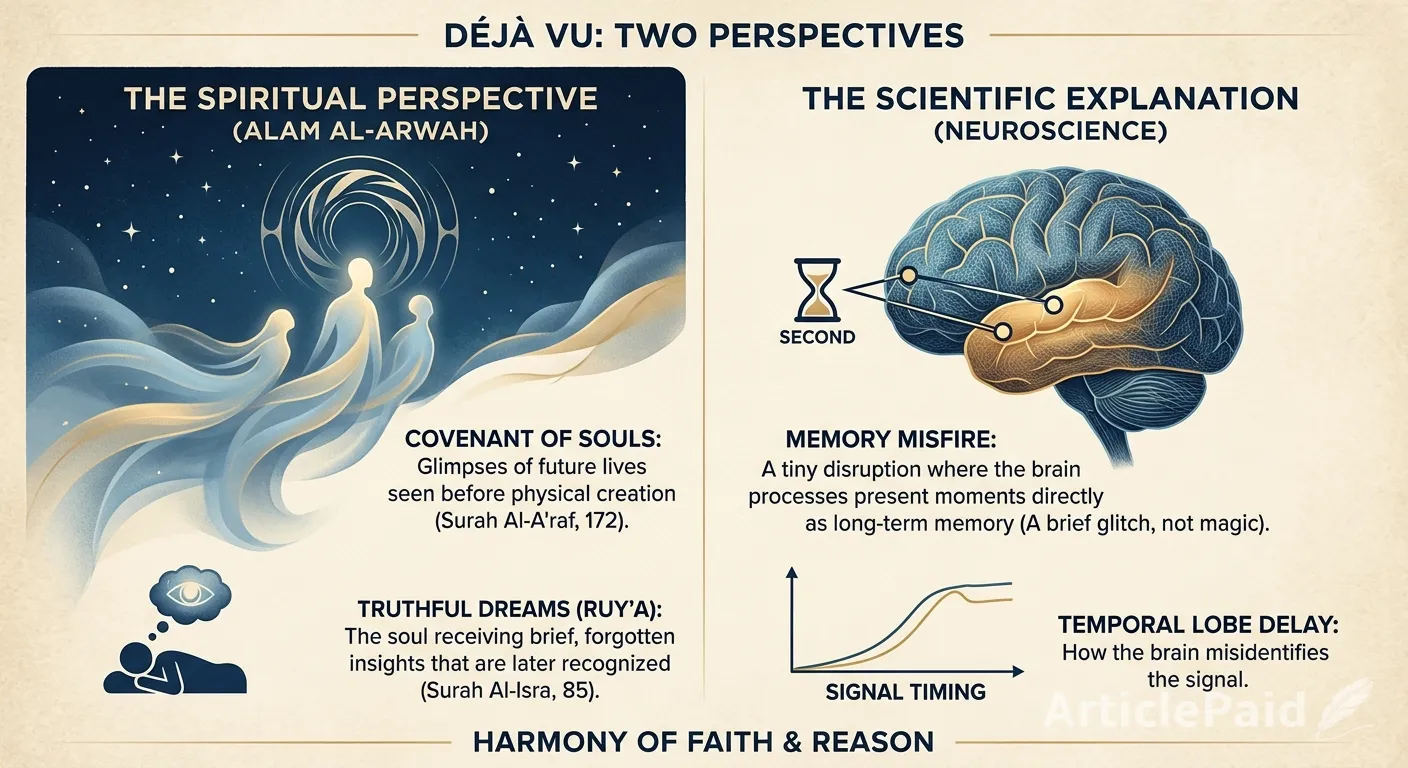
Many people have linked déjà vu to dreams, past lives and supernatural experiences. However, neuroscience has suggested some explanations behind this.
Although scientists have made huge developments, the exact reason is still not fully understood. By researching déjà vu, we can gain more understanding about how our brains process memories and why some déjà vu experiences are not actually based on real memories.
1. What is Déjà Vu?
Déjà vu is when you feel like you have already experienced the current situation.
For example, you might feel like you have been seated at the same table or had the same conversation while visiting a new restaurant. This can be very convincing as you have no clear memory of this.
When we experience déjà vu we often feel a sense of familiarity. However, this would be different to a memory as you can recall details of a real memory.
During déjà vu you will often feel familiar but cannot identify a real memory. This is often only a few seconds long.
2. How Common is Déjà Vu?
Interestingly, déjà vu is a very common experience. Research suggests that most people will have experienced it at least once.
A systematic review and meta-analysis was conducted in 2024 looking at research into déjà vu in healthy individuals and individuals with epilepsy. This showed that estimates can vary depending on the definition, population and methodology used by researchers.
Some people only experience it occasionally, whereas others notice it more. This does not necessarily mean there is a problem with their memory or brain function.
It is important to understand déjà vu as it is very common and gives us insight into how our brains function during everyday cognitive tasks.
3. Memory Processes in the Brain
Our brain has several interconnected processes that help recognise familiar information and remember our past. The hippocampus and surrounding areas of the temporal lobes are important.
The hippocampus plays an important role in forming and recalling memories of personal experiences. Other areas help recognise objects, locations and information that we have seen before.
Familiarity vs Recall
This refers to when we feel familiar with something. Recalling refers to when we can remember details about when or where something happened.
For example, you may feel familiarity with someone’s face but cannot remember their name. However, if you later realise you met them at school then you are recalling extra information.
During déjà vu you may feel familiar but cannot identify any real memories. This is often only a few seconds long.
4. Mismatch in Familiarity
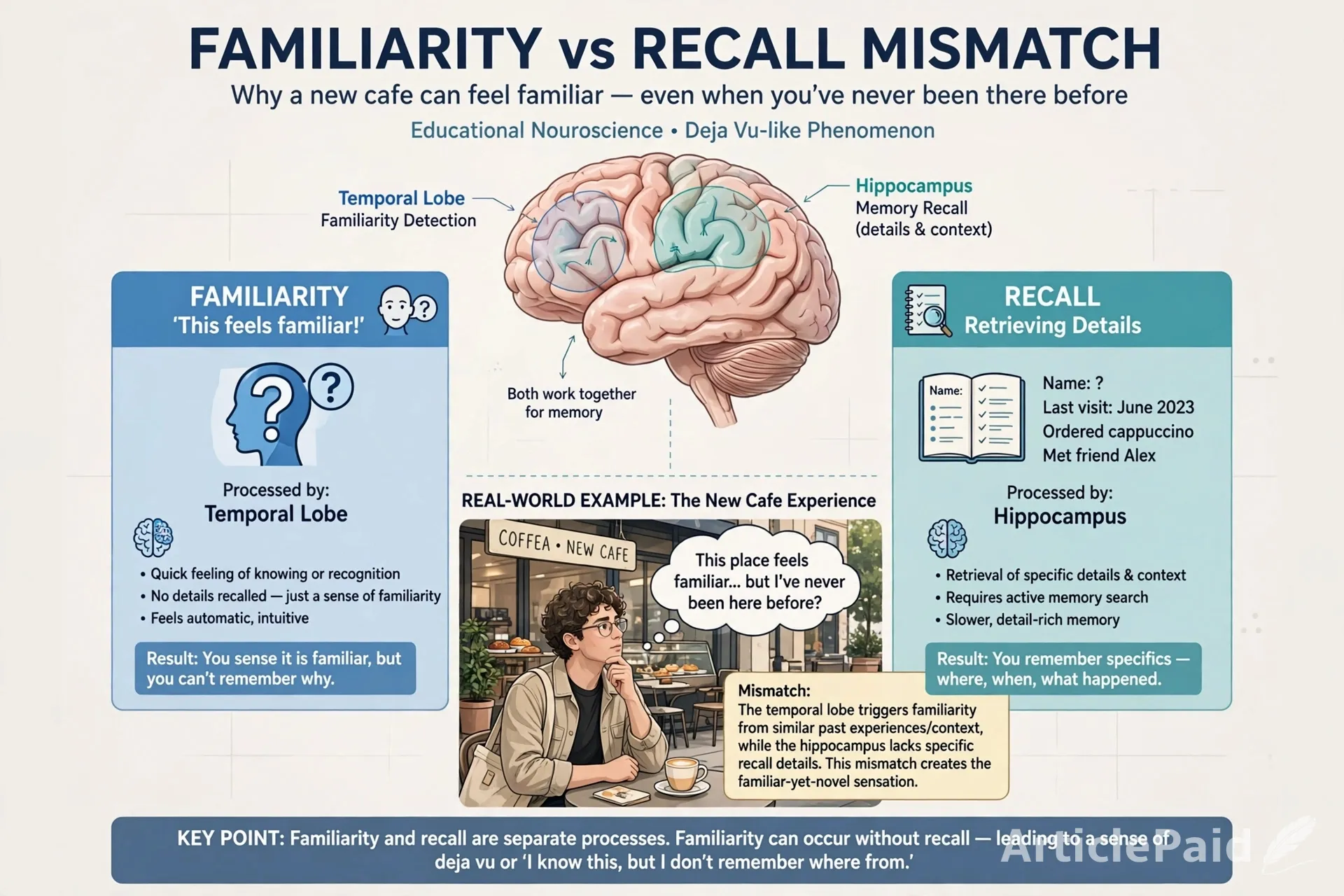
One of the main explanations for déjà vu is that your brain creates a strong sense of familiarity but cannot recall any memories.
Imagine walking into a room that you have not been to before. However, it looks like somewhere you have been to years ago. You may feel like you have been in this situation before due to similar furniture, lighting and layout.
Normally your brain would recognise the similarities but during déjà vu you may feel like you recognise something without a clear reason.
Another theory suggests that your brain recognises there is a conflict between familiarity and knowing it is a new situation.
This may be why you feel like it is such a strange experience. One part of your brain is suggesting you feel familiar with the situation but another part cannot find any evidence of this.
These are promising theories but scientists are still looking into how this can occur.
5. Processing Information at the Wrong Time?
Another explanation suggests that your brain processes information at an unusual time.
When you walk into a room your brain combines visual information, sounds, spatial information, and memories to create a cohesive experience. This is normally done well.
Some researchers have suggested that processing information at an unusual time could cause a sense of familiarity.
However, scientists have not found evidence to suggest that normal déjà vu is generally caused by a delay in sensory information.
What we do know is that your brain combines several processes to recognise experiences. This mismatch could be why you feel like something new is familiar.
6. Brain Networks and Awareness
Déjà vu can also raise questions about how our brain judges our own experiences. This is related to metacognition, meaning monitoring our own thoughts.
When you experience déjà vu you may think ‘I feel familiar with this but I know I have never been here’. You are feeling familiar but questioning whether this is true.
Research suggests that brain networks related to memories along with systems that process conflicting information can contribute to this.
Brain scans can help scientists identify patterns that occur during déjà vu but we cannot yet identify one complete explanation.
This shows us that there is a link between recognising experiences and deciding whether they are justified.
7. Why it Can Be Convincing
Déjà vu can often feel very convincing as familiarity is often automatic.
When you suddenly feel that something new is familiar your brain will naturally try to think of an explanation. Because you cannot identify any clear memories, this can make it seem like a mystery.
However, just because you feel strongly does not mean that something has happened before. Your brain signals for familiarity can be very useful for recognising things in everyday life but can sometimes be misleading.
Déjà vu shows us that there is a difference between feeling something and knowing it is accurate.
8. Is Déjà Vu Connected to Dreams?
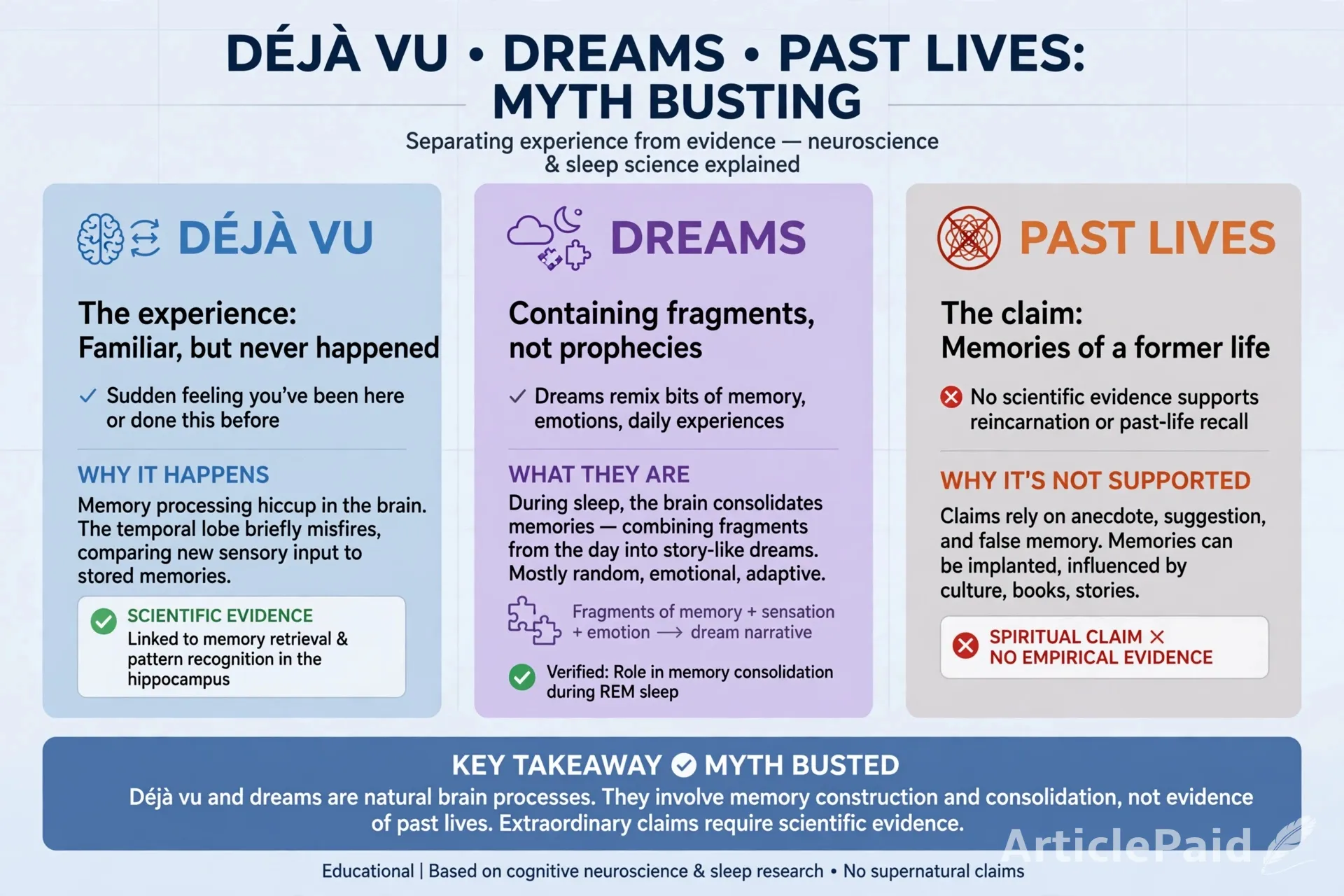
Many people believe that déjà vu occurs because they have dreamt about this situation before. Seeing a familiar scene can make you think back to a dream you remember having weeks or months ago.
Dreams often contain pieces of information about familiar places, conversations, feelings and memories. This can create a strong sense of familiarity when you see similar details.
However, our memories of our dreams can change. As our memories are reconstructive our dreams may seem more related to the current event.
This could explain some instances of déjà vu linked to dreams. However, there is no reliable scientific evidence to show that déjà vu proves that our dreams can predict future events.
This is an interesting area to research further.
9. Does Déjà Vu Mean You Have Lived a Previous Life?
In some spiritual beliefs déjà vu can be seen as a sign of a link to reincarnation or past lives. For those who believe this it can have a personal or spiritual meaning.
Science requires evidence that can be tested and analysed. Feeling familiar with a place or event does not prove someone has had this experience in a past life.
Research into memories has shown there are possible explanations for why we can feel strange familiarity with unfamiliar situations.
Whilst people can reflect on what this means to them personally, it is important to differentiate between spiritual beliefs and scientific conclusions.
Currently, there is no evidence to prove that déjà vu can give evidence of past lives.
10. Can Stress, Fatigue, or Lack of Sleep Trigger Déjà Vu?
Some people report experiencing déjà vu more when they are tired, stressed or not sleeping well.
Lack of sleep and stress can impact your attention, concentration and memory. This can affect how you process information.
However, it has not been established that stress or tiredness directly causes every instance of déjà vu.
Keeping a healthy sleep routine and managing your stress can help keep your brain healthy overall.
If you are experiencing déjà vu regularly or alongside other worrying symptoms it may be a good idea to seek medical advice.
11. Why Do Some People Experience It More?
People can experience different amounts of déjà vu. Researchers have looked into reasons why this could happen including age, memory, attention and unfamiliar environments.
Age and life experiences
Studies often suggest younger people experience it more often. However, this can vary between individuals and the reasons for this are not fully understood.
Travel
Travelling can expose you to unfamiliar places which can have familiar elements. This can contribute to feelings of familiarity. However, it has not been established that this directly causes déjà vu.
Attention and Memory
Just because you experience déjà vu does not mean you have a better memory or memory problems. Research has not shown a simple link between how much you experience and how good your memory is.
Individual differences may be due to several factors.
12. Déjà Vu and Epilepsy: When Familiarity Has a Medical Significance
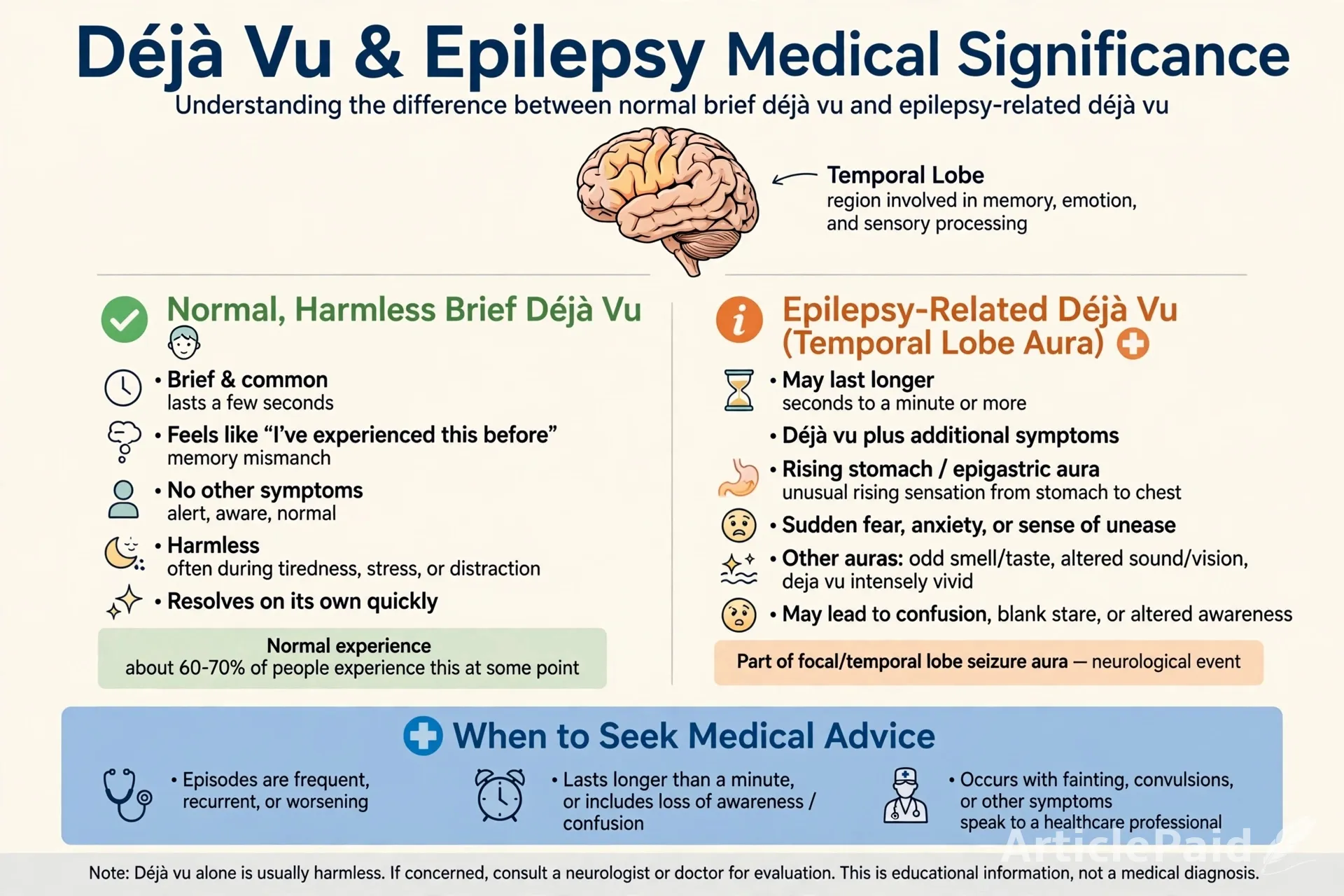
Generally normal déjà vu is harmless. However, similar sensations can occur with certain neurological conditions including temporal lobe epilepsy.
Some people who suffer from focal seizures can experience sudden feelings of familiarity, intense fear, strange smells/tastes and a feeling of rising in their stomach. They may also experience changes in their awareness.
Just because you experience déjà vu does not mean you have epilepsy. Doctors will take into account how often you experience it, how long they last, any other symptoms and your medical history.
A systematic review was conducted in 2024 looking at differences between non-epileptic and epilepsy-related déjà vu (Frontiers in Neurology).
When to Seek Medical Advice
If you are experiencing it unusually often, alongside memory loss or alongside confusion, uncontrollable movements or changes in awareness it may be a good idea to seek advice from a healthcare professional.
Whilst this does not necessarily mean you have epilepsy it is important to have it assessed properly. If you are experiencing any symptoms of a suspected seizure this should be urgently assessed by a doctor.
Generally, if it occurs occasionally and lasts for a short amount of time without any other symptoms it is less concerning.
13. Can Scientists Create Déjà Vu?
It can be difficult to research déjà vu as it cannot be reliably created.
Scientists research similar processes by conducting memory tasks, brain scans, virtual environments and observing patients.
They may ask participants to recognise familiar images or scenes. They may also look at situations where people feel familiarity without recalling any memories.
Studies into those with epilepsy have also given us insight into the areas of the brain linked to unusual feelings of familiarity.
However, the feelings created in experiments may not be the same as normal déjà vu. Scientists need to be careful to differentiate between different experiences.
Further research may help us understand how familiarity, recall and awareness interact.
14. What Does Déjà Vu Tell Us About Human Memory?
Our memory is not like a video camera and does not record everything perfectly. Our brains use stored information, links, and context to create memories.
This helps us learn from our past, recognise familiar people and make decisions. However, this can mean that sometimes our feelings of familiarity are inaccurate.
Déjà vu shows us this as we experience a sense of familiarity without any clear memories.
This can happen in everyday life too. We may feel like something is true due to it feeling familiar because it is said often.
Understanding this helps us to be cautious about any strong impressions we have.
15. Is Déjà Vu Harmful?
For most people it is harmless to experience occasional déjà vu. It usually only lasts a few seconds and does not impact your everyday activities.
It does not necessarily mean you have a memory issue, mental health issue or neurological illness.
However, if you are experiencing it often, causing disruption, or experiencing it alongside changes in awareness it is important to consider the bigger picture.
You do not need to worry about short moments of déjà vu. A balanced approach would be to understand it is a common experience and seek professional advice if it is becoming a concern.
16. Common Myths
As déjà vu can feel mysterious there are several popular myths. Here are some key points to help differentiate between scientific evidence and speculation.
Myth 1 – It Proves You Have Seen the Future
Feeling familiar does not mean you have seen it in the future. There is no reliable evidence that normal déjà vu proves this.
Myth 2 – Everyone Who Experiences It Has Epilepsy
Many healthy people experience déjà vu. Whilst it can occur alongside certain seizures it does not prove someone has epilepsy.
Myth 3 – It Shows You Have an Amazing Memory
There is no evidence to suggest those who experience it often have an amazing memory. It is more directly related to feelings of familiarity.
Myth 4 – It is Always Caused by Stress
While stress may affect your cognitive function, it is not proven to be a universal cause. There may be several factors that contribute.
Myth 5 – Scientists Know Everything
Scientists have come up with useful explanations relating to memories and how our brain functions. However, the exact causes of normal déjà vu are still being researched.
17. How to Respond When Déjà Vu Happens
When you experience a normal instance there is nothing special you need to do. Simply recognise that you are experiencing it.
If you are curious, you may want to note when it occurs, how long it lasts and if it occurs alongside tiredness or other symptoms.
It can be helpful to recognise that it is a feeling rather than a conclusion. ‘I feel like I have been here before’ is a more accurate statement than ‘I must have been here’.
If you are experiencing it often or experiencing it alongside unusual symptoms, it would be more appropriate to talk to a healthcare professional about the pattern.
For most people it is simply an interesting experience.
18. What Scientists Still Want to Know
Scientists are still researching why our brains create feelings of déjà vu and why sometimes we feel familiarity without being able to recall any memories.
An important question is whether different instances are caused by the same mechanism or several processes creating similar feelings.
Researchers want to understand why some instances are short lasting and others feel very emotional. They also want to understand how attention, age and sleep can impact this.
Further research into memory networks and awareness may help answer these questions.
While it is not fully understood,, every discovery helps us understand more about how our brains recognise experiences and judge our own memories.
Conclusion – A Short Mystery With Lots to Learn
Déjà vu is a strange feeling that you have already experienced the current moment. Research suggests it may be due to mismatched familiarity and inability to recall real memories.
The hippocampus and other memory areas of the brain contribute to recognition. However, there is no one explanation for every instance. Scientists continue to research how these processes interact.
For most people it is harmless to experience occasional déjà vu. It does not prove that our dreams can predict the future or that we have lived a past life. However, if you are experiencing it often alongside neurological symptoms, it would be a good idea to seek medical advice.
Overall it shows us something fascinating about our minds. We can often feel very strongly about our feelings of recognition but they are not always an accurate representation of our past.
Next time you feel like somewhere new feels familiar to you, remember that it may be due to how complex our brains process our memories. A short reminder that even our strongest feelings in our minds can have more complex explanations.



















Responses (0)
Sign in to share your thoughts.
Sign in