
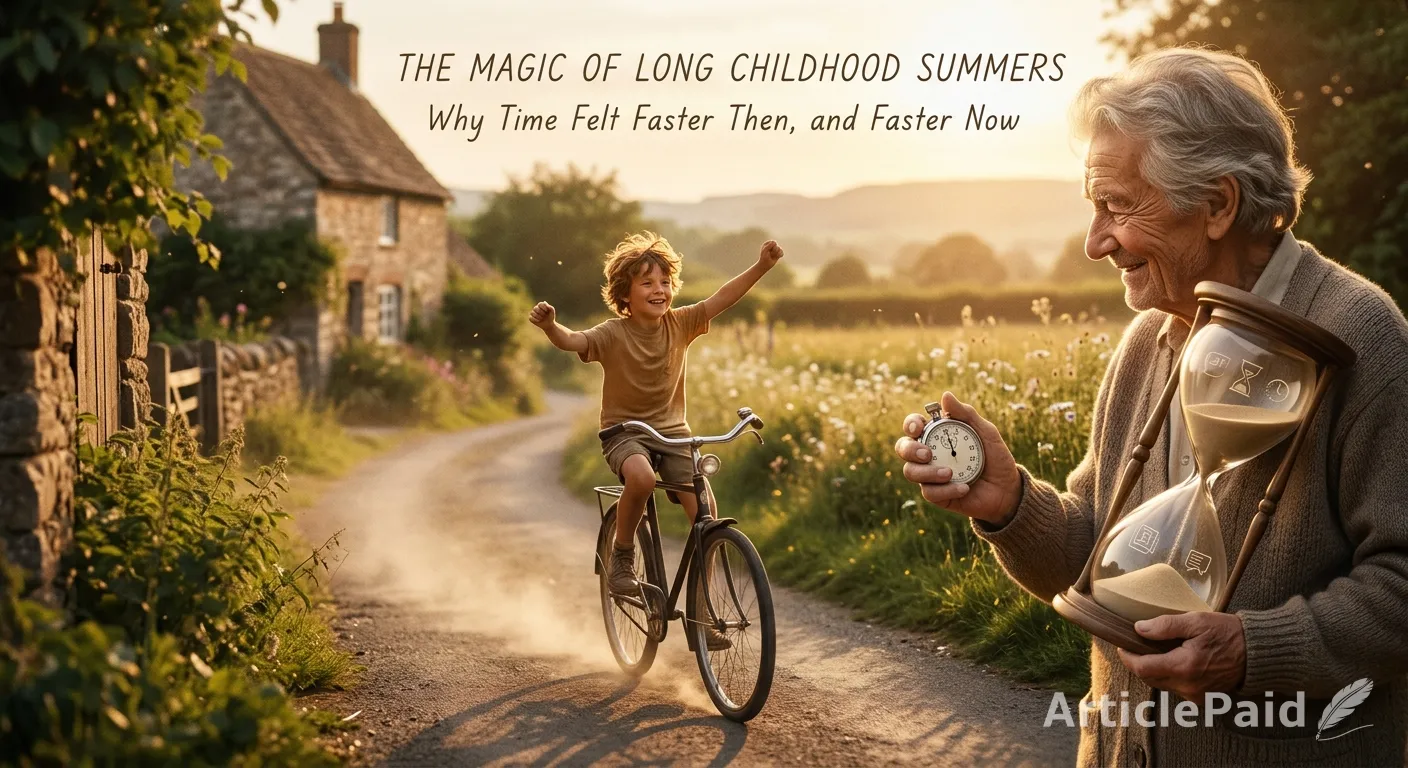
Why Time Feels So Long When We're Young
It’s funny how time works, isn't it? When you're a kid, a single year feels like an entire epoch. You’d spend what felt like half a lifetime waiting for your next birthday or for summer to roll around. But as we get older, those same twelve months seem to zoom past before we even have time to settle in.
It turns out you’re definitely not imagining things—and you aren't alone. Scientists, psychologists, and neuroscientists have spent decades studying this exact phenomenon. The good news? You aren't losing your mind; your brain is just doing what it’s naturally wired to do.
Here is the fascinating science behind why time seems to speed up as we grow older—and what we can do to make it feel more meaningful.1. The Math of Time: The "Proportional Theory"
One of the simplest ways to understand this feeling comes down to basic math, often described as the proportional theory of time perception.
Think of your life as a growing collection of memories:
Age 5: A single year represents a massive 20% of your life so far. That's a huge fraction! Everything you experience during those twelve months makes up a significant portion of your memories.
Age 20: That same one-year span shrinks to just 5% of your life so far.
Age 50: A single year represents only 2% of your life so far.Our minds naturally compare the present against the backdrop of everything we've already lived through. To a five-year-old, a year can feel like a giant piece of the pie. But as the pie grows bigger, each new year becomes a smaller slice.
This theory offers an intuitive way to understand why time can seem to accelerate with age, although it is not a complete scientific explanation for the phenomenon.2. Brain Frame Rate: How Fast We Process the World
Think of your brain like a camera taking mental snapshots of the world.
When we're young, our brains are developing rapidly and learning to process an enormous amount of new information. Every unfamiliar face, sound, place, and experience gives us something new to notice.
Some explanations of time perception compare this process to a camera's frame rate. The idea is that changes in how the brain processes information might influence how we experience time. However, the claim that children's brains simply process more frames per second and that this directly makes time feel slower is not an established scientific explanation.
Instead, our perception of time is influenced by several factors, including attention, memory, and the way we interpret events. When we look back on a period filled with vivid experiences, it can feel longer and richer than a period that left behind few distinctive memories.3. The Power of "Firsts": Novelty vs. Routine
Cast your mind back to when you were a kid. Almost every day seemed to bring something entirely new:
Learning to ride a bike without training wheels.
Walking into a brand-new classroom on the first day of school.
Tasting a dish you had never tried before.
Exploring a new park or neighborhood at the edge of town.
When your brain encounters fresh experiences, it has more unfamiliar details to notice and remember. These experiences can create vivid, deeply textured memories that make a period of life feel substantial when you look back on it.
As we grow older, though, we often fall into comfortable rhythms. We take the same route to work or school, eat familiar meals, and follow predictable schedules. Our brains become more efficient at handling familiar situations, so everyday activities may require less conscious attention.
When fewer distinctive memories are formed, whole weeks or months can blend together in hindsight. It can feel as if time simply vanished into thin air.
That may help explain why a childhood summer vacation can seem to have lasted an entire lifetime, while a recent month feels as though it disappeared almost overnight.
4. The Magic of Long Childhood SummersHave you ever looked back at a summer vacation from when you were seven or eight years old and remembered it feeling like an absolute lifetime?
Whole sagas seemed to unfold between June and September! There were new games to invent, places to explore, friendships to build, and countless little adventures that made ordinary days feel extraordinary.
Fast-forward to today, and suddenly weeks, months, or even entire years seem to slip through our fingers like sand. January arrives, you blink, and all of a sudden you're buying holiday presents again.
Part of this difference may come from the number of new and memorable experiences we collect. Childhood is often filled with firsts, while later life can contain more repeated routines. As a result, looking back on childhood may reveal a dense collection of distinct memories, whereas recent periods can seem less eventful in retrospect.
There is another important distinction, too: time can feel slow while we're waiting for something to happen, yet seem short when we look back on it. These are different aspects of time perception, and both help explain why our experience of time can be so strange.

5. How to Press the "Pause" Button
While we can't alter the clock or stop ourselves from growing older, we can make our days feel more engaging and memorable. One helpful approach is to bring novelty and attention back into everyday life.
Here are a few gentle ways to do that:Break your routines: Take a different route, pick up a fresh hobby, or try cooking a meal from a cuisine you've never explored before. Small changes can give your mind something new to notice.Practice mindfulness: Pause for a moment to tune into your senses. Feel the cool breeze, listen to the sounds around you, or savor the aroma of your morning tea. Paying attention to the present can make an ordinary moment feel more vivid.Create meaningful memories: Spend time with people you care about, visit unfamiliar places when possible, or keep a journal of the little things that made your day special. Looking back at these moments can help you recognize how much life contains.Notice the ordinary: Not every memorable moment needs to be a grand adventure. Sometimes, the sound of rain against a window, a conversation that makes you think, or an unexpected laugh can become a lasting memory.
These habits won't literally slow the clock, and they cannot guarantee that time will feel longer. However, they can help you pay more attention to your experiences and build a richer collection of memories.
The Final Thought
Time may naturally feel as though it's moving faster as the years roll on, but our experience of it isn't fixed. Memory, attention, routine, and novelty all play a part in how we perceive the passage of time.
Perhaps the secret isn't to make every day feel longer. Perhaps it's to make every day feel like it truly happened.
After all, we cannot add more hours to a day or return to the summers of our childhood. But we can keep discovering new things, noticing the world around us, and creating memories that make the years feel full rather than fleeting.
More from ArticlePaid

The Fascinating World of Science Museums: A Journey Through
IntroductionScience museums are more than just buildings filled with objects; they are gateways to discovery, learning, and innovation. These institutions
790 views
0 comments

Why Humans Are the Only Animals That Cry Emotional Tears,
It is common to our species to cry as a form of expression. People cry when they are feeling sad, overwhelmingly happy, saying goo...
5 views
0 comments

Tsunami Warning in California: Here are the Details
A powerful 8.8 magnitude earthquake off Kamchatka triggered tsunami warnings for California, Hawaii, Oregon, Washington—here’s what you need to know.
226 views
0 comments

The Voynich Manuscript: The 600-Year-Old Book No One Has Ever Been Able to Read
A Mystery That Has Defied Six CenturiesImagine walking into an ancient library and discovering a weathered book unlike anything yo...
29 views
0 comments

What Would Happen If Honey Bees Disappeared?
What Would Happen If Bees Disappeared?Imagine waking up one morning to a world without bees. At first, it might not seem like a bi...
3 views
0 comments
Brain Learning Human vs Animals
Research uncovers how the brain processes learning by identifying the exact moment an animal learns a new skill. By observing brain, neurons in mice, scientists found that learning occurs much faster than previously thought, in as few as 20 to 40 tries.
171 views
0 comments

How Science Is Helping Us Understand a Changing Planet
Our planet is constantly changing, and science helps us understand what is happening beneath our feet, in the oceans, in the atmos...
8 views
0 comments
Urban Micro-Forests: How Tiny Green Pocket Parks Are Saving Modern Cities
In concrete jungles across the globe, a green revolution is taking root in the unlikeliest of places. Unused parking spaces, negle...
9 views
0 comments
Nanozymes in Healthcare: The Tiny Catalysts Rewriting Medicine
Imagine an enzyme and a nanoparticle had a baby. It would be super stable, work in extreme heat and acid, cost almost nothing to m...
24 views
0 comments
Weekly Top Articles

Easy Potato Cheese Balls Yammy and cryspy
Easy Potato Cheese Balls Recipe at Home Potato Cheese Balls Recipe is a delicious and easy snack that you can prepare at home with...

Sweet Memories Come from Good Taste #memories
Food is more than just something we eat to satisfy our hunger. It is a beautiful part of our lives that connects us with our emoti...

Why People Are Choosing Situationships Over Commitment,
You’ve probably been there. Texting someone almost every day, sharing late-night calls, weekend sleepovers, inside jokes, and genu...

Healthy soup for cold& cough- comforting Ginger Garlic soup
IntroductionWarm up with this easy, healthy and tasty homemade Ginger Garlic Soup. This soup has been made using fresh ingredients...

How Can I Use AI to Grow My Business and Make More Money in 2026?
IntroductionArtificial intelligence can make life easier for entrepreneurs, both big and small. Using artificial intelligence tool...
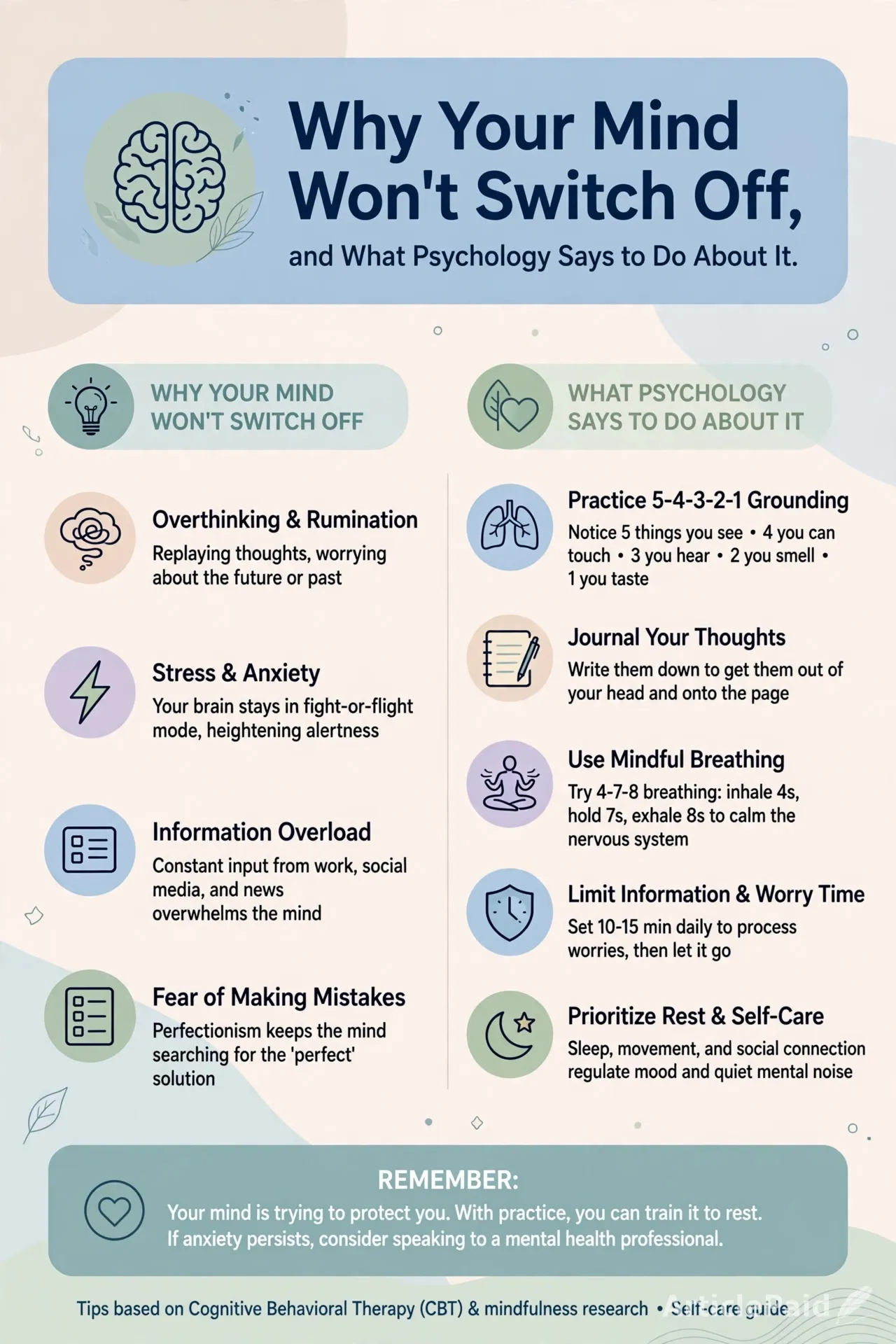
Why Your Mind Won't Switch Off, and What Psychology Says to Do About It
Last month's embarrassing text. Tomorrow's presentation. A decision you've already made but keep re-examining like it's evidence i...
It turns out you’re definitely not imagining things—and you aren't alone. Scientists, psychologists, and neuroscientists have spent decades studying this exact phenomenon. The good news? You aren't losing your mind; your brain is just doing what it’s naturally wired to do.
Here is the fascinating science behind why time seems to speed up as we grow older—and what we can do to make it feel more meaningful.
Think of your life as a growing collection of memories:
Age 5: A single year represents a massive 20% of your life so far. That's a huge fraction! Everything you experience during those twelve months makes up a significant portion of your memories.
Age 20: That same one-year span shrinks to just 5% of your life so far.
Age 50: A single year represents only 2% of your life so far.
This theory offers an intuitive way to understand why time can seem to accelerate with age, although it is not a complete scientific explanation for the phenomenon.
2. Brain Frame Rate: How Fast We Process the World
Think of your brain like a camera taking mental snapshots of the world.
When we're young, our brains are developing rapidly and learning to process an enormous amount of new information. Every unfamiliar face, sound, place, and experience gives us something new to notice.
Some explanations of time perception compare this process to a camera's frame rate. The idea is that changes in how the brain processes information might influence how we experience time. However, the claim that children's brains simply process more frames per second and that this directly makes time feel slower is not an established scientific explanation.
Instead, our perception of time is influenced by several factors, including attention, memory, and the way we interpret events. When we look back on a period filled with vivid experiences, it can feel longer and richer than a period that left behind few distinctive memories.3. The Power of "Firsts": Novelty vs. Routine
Cast your mind back to when you were a kid. Almost every day seemed to bring something entirely new:
Learning to ride a bike without training wheels.
Walking into a brand-new classroom on the first day of school.
Tasting a dish you had never tried before.
Exploring a new park or neighborhood at the edge of town.
When your brain encounters fresh experiences, it has more unfamiliar details to notice and remember. These experiences can create vivid, deeply textured memories that make a period of life feel substantial when you look back on it.
As we grow older, though, we often fall into comfortable rhythms. We take the same route to work or school, eat familiar meals, and follow predictable schedules. Our brains become more efficient at handling familiar situations, so everyday activities may require less conscious attention.
When fewer distinctive memories are formed, whole weeks or months can blend together in hindsight. It can feel as if time simply vanished into thin air.
That may help explain why a childhood summer vacation can seem to have lasted an entire lifetime, while a recent month feels as though it disappeared almost overnight.
4. The Magic of Long Childhood SummersHave you ever looked back at a summer vacation from when you were seven or eight years old and remembered it feeling like an absolute lifetime?
Whole sagas seemed to unfold between June and September! There were new games to invent, places to explore, friendships to build, and countless little adventures that made ordinary days feel extraordinary.
Fast-forward to today, and suddenly weeks, months, or even entire years seem to slip through our fingers like sand. January arrives, you blink, and all of a sudden you're buying holiday presents again.
Part of this difference may come from the number of new and memorable experiences we collect. Childhood is often filled with firsts, while later life can contain more repeated routines. As a result, looking back on childhood may reveal a dense collection of distinct memories, whereas recent periods can seem less eventful in retrospect.
There is another important distinction, too: time can feel slow while we're waiting for something to happen, yet seem short when we look back on it. These are different aspects of time perception, and both help explain why our experience of time can be so strange.
5. How to Press the "Pause" Button
While we can't alter the clock or stop ourselves from growing older, we can make our days feel more engaging and memorable. One helpful approach is to bring novelty and attention back into everyday life.
Here are a few gentle ways to do that:Break your routines: Take a different route, pick up a fresh hobby, or try cooking a meal from a cuisine you've never explored before. Small changes can give your mind something new to notice.Practice mindfulness: Pause for a moment to tune into your senses. Feel the cool breeze, listen to the sounds around you, or savor the aroma of your morning tea. Paying attention to the present can make an ordinary moment feel more vivid.Create meaningful memories: Spend time with people you care about, visit unfamiliar places when possible, or keep a journal of the little things that made your day special. Looking back at these moments can help you recognize how much life contains.Notice the ordinary: Not every memorable moment needs to be a grand adventure. Sometimes, the sound of rain against a window, a conversation that makes you think, or an unexpected laugh can become a lasting memory.
These habits won't literally slow the clock, and they cannot guarantee that time will feel longer. However, they can help you pay more attention to your experiences and build a richer collection of memories.
The Final Thought
Time may naturally feel as though it's moving faster as the years roll on, but our experience of it isn't fixed. Memory, attention, routine, and novelty all play a part in how we perceive the passage of time.
Perhaps the secret isn't to make every day feel longer. Perhaps it's to make every day feel like it truly happened.
After all, we cannot add more hours to a day or return to the summers of our childhood. But we can keep discovering new things, noticing the world around us, and creating memories that make the years feel full rather than fleeting.
More from ArticlePaid
The Fascinating World of Science Museums: A Journey Through
IntroductionScience museums are more than just buildings filled with objects; they are gateways to discovery, learning, and innovation. These institutions
790 views
0 comments
Why Humans Are the Only Animals That Cry Emotional Tears,
It is common to our species to cry as a form of expression. People cry when they are feeling sad, overwhelmingly happy, saying goo...
5 views
0 comments
Tsunami Warning in California: Here are the Details
A powerful 8.8 magnitude earthquake off Kamchatka triggered tsunami warnings for California, Hawaii, Oregon, Washington—here’s what you need to know.
226 views
0 comments
The Voynich Manuscript: The 600-Year-Old Book No One Has Ever Been Able to Read
A Mystery That Has Defied Six CenturiesImagine walking into an ancient library and discovering a weathered book unlike anything yo...
29 views
0 comments
What Would Happen If Honey Bees Disappeared?
What Would Happen If Bees Disappeared?Imagine waking up one morning to a world without bees. At first, it might not seem like a bi...
3 views
0 comments
Brain Learning Human vs Animals
Research uncovers how the brain processes learning by identifying the exact moment an animal learns a new skill. By observing brain, neurons in mice, scientists found that learning occurs much faster than previously thought, in as few as 20 to 40 tries.
171 views
0 comments
How Science Is Helping Us Understand a Changing Planet
Our planet is constantly changing, and science helps us understand what is happening beneath our feet, in the oceans, in the atmos...
8 views
0 comments
Urban Micro-Forests: How Tiny Green Pocket Parks Are Saving Modern Cities
In concrete jungles across the globe, a green revolution is taking root in the unlikeliest of places. Unused parking spaces, negle...
9 views
0 comments
Nanozymes in Healthcare: The Tiny Catalysts Rewriting Medicine
Imagine an enzyme and a nanoparticle had a baby. It would be super stable, work in extreme heat and acid, cost almost nothing to m...
24 views
0 comments
Weekly Top Articles
Easy Potato Cheese Balls Yammy and cryspy
Easy Potato Cheese Balls Recipe at Home Potato Cheese Balls Recipe is a delicious and easy snack that you can prepare at home with...
Sweet Memories Come from Good Taste #memories
Food is more than just something we eat to satisfy our hunger. It is a beautiful part of our lives that connects us with our emoti...
Why People Are Choosing Situationships Over Commitment,
You’ve probably been there. Texting someone almost every day, sharing late-night calls, weekend sleepovers, inside jokes, and genu...
Healthy soup for cold& cough- comforting Ginger Garlic soup
IntroductionWarm up with this easy, healthy and tasty homemade Ginger Garlic Soup. This soup has been made using fresh ingredients...
How Can I Use AI to Grow My Business and Make More Money in 2026?
IntroductionArtificial intelligence can make life easier for entrepreneurs, both big and small. Using artificial intelligence tool...
Why Your Mind Won't Switch Off, and What Psychology Says to Do About It
Last month's embarrassing text. Tomorrow's presentation. A decision you've already made but keep re-examining like it's evidence i...
When we're young, our brains are developing rapidly and learning to process an enormous amount of new information. Every unfamiliar face, sound, place, and experience gives us something new to notice.
Some explanations of time perception compare this process to a camera's frame rate. The idea is that changes in how the brain processes information might influence how we experience time. However, the claim that children's brains simply process more frames per second and that this directly makes time feel slower is not an established scientific explanation.
Instead, our perception of time is influenced by several factors, including attention, memory, and the way we interpret events. When we look back on a period filled with vivid experiences, it can feel longer and richer than a period that left behind few distinctive memories.
Learning to ride a bike without training wheels.
Walking into a brand-new classroom on the first day of school.
Tasting a dish you had never tried before.
Exploring a new park or neighborhood at the edge of town.
When your brain encounters fresh experiences, it has more unfamiliar details to notice and remember. These experiences can create vivid, deeply textured memories that make a period of life feel substantial when you look back on it.
As we grow older, though, we often fall into comfortable rhythms. We take the same route to work or school, eat familiar meals, and follow predictable schedules. Our brains become more efficient at handling familiar situations, so everyday activities may require less conscious attention.
When fewer distinctive memories are formed, whole weeks or months can blend together in hindsight. It can feel as if time simply vanished into thin air.
That may help explain why a childhood summer vacation can seem to have lasted an entire lifetime, while a recent month feels as though it disappeared almost overnight.
4. The Magic of Long Childhood Summers
Have you ever looked back at a summer vacation from when you were seven or eight years old and remembered it feeling like an absolute lifetime?
Whole sagas seemed to unfold between June and September! There were new games to invent, places to explore, friendships to build, and countless little adventures that made ordinary days feel extraordinary.
Fast-forward to today, and suddenly weeks, months, or even entire years seem to slip through our fingers like sand. January arrives, you blink, and all of a sudden you're buying holiday presents again.
Part of this difference may come from the number of new and memorable experiences we collect. Childhood is often filled with firsts, while later life can contain more repeated routines. As a result, looking back on childhood may reveal a dense collection of distinct memories, whereas recent periods can seem less eventful in retrospect.
There is another important distinction, too: time can feel slow while we're waiting for something to happen, yet seem short when we look back on it. These are different aspects of time perception, and both help explain why our experience of time can be so strange.
5. How to Press the "Pause" Button
While we can't alter the clock or stop ourselves from growing older, we can make our days feel more engaging and memorable. One helpful approach is to bring novelty and attention back into everyday life.
Here are a few gentle ways to do that:Break your routines: Take a different route, pick up a fresh hobby, or try cooking a meal from a cuisine you've never explored before. Small changes can give your mind something new to notice.Practice mindfulness: Pause for a moment to tune into your senses. Feel the cool breeze, listen to the sounds around you, or savor the aroma of your morning tea. Paying attention to the present can make an ordinary moment feel more vivid.Create meaningful memories: Spend time with people you care about, visit unfamiliar places when possible, or keep a journal of the little things that made your day special. Looking back at these moments can help you recognize how much life contains.Notice the ordinary: Not every memorable moment needs to be a grand adventure. Sometimes, the sound of rain against a window, a conversation that makes you think, or an unexpected laugh can become a lasting memory.
These habits won't literally slow the clock, and they cannot guarantee that time will feel longer. However, they can help you pay more attention to your experiences and build a richer collection of memories.
The Final Thought
Time may naturally feel as though it's moving faster as the years roll on, but our experience of it isn't fixed. Memory, attention, routine, and novelty all play a part in how we perceive the passage of time.
Perhaps the secret isn't to make every day feel longer. Perhaps it's to make every day feel like it truly happened.
After all, we cannot add more hours to a day or return to the summers of our childhood. But we can keep discovering new things, noticing the world around us, and creating memories that make the years feel full rather than fleeting.
More from ArticlePaid
The Fascinating World of Science Museums: A Journey Through
IntroductionScience museums are more than just buildings filled with objects; they are gateways to discovery, learning, and innovation. These institutions
790 views
0 comments
Why Humans Are the Only Animals That Cry Emotional Tears,
It is common to our species to cry as a form of expression. People cry when they are feeling sad, overwhelmingly happy, saying goo...
5 views
0 comments
Tsunami Warning in California: Here are the Details
A powerful 8.8 magnitude earthquake off Kamchatka triggered tsunami warnings for California, Hawaii, Oregon, Washington—here’s what you need to know.
226 views
0 comments
The Voynich Manuscript: The 600-Year-Old Book No One Has Ever Been Able to Read
A Mystery That Has Defied Six CenturiesImagine walking into an ancient library and discovering a weathered book unlike anything yo...
29 views
0 comments
What Would Happen If Honey Bees Disappeared?
What Would Happen If Bees Disappeared?Imagine waking up one morning to a world without bees. At first, it might not seem like a bi...
3 views
0 comments
Brain Learning Human vs Animals
Research uncovers how the brain processes learning by identifying the exact moment an animal learns a new skill. By observing brain, neurons in mice, scientists found that learning occurs much faster than previously thought, in as few as 20 to 40 tries.
171 views
0 comments
How Science Is Helping Us Understand a Changing Planet
Our planet is constantly changing, and science helps us understand what is happening beneath our feet, in the oceans, in the atmos...
8 views
0 comments
Urban Micro-Forests: How Tiny Green Pocket Parks Are Saving Modern Cities
In concrete jungles across the globe, a green revolution is taking root in the unlikeliest of places. Unused parking spaces, negle...
9 views
0 comments
Nanozymes in Healthcare: The Tiny Catalysts Rewriting Medicine
Imagine an enzyme and a nanoparticle had a baby. It would be super stable, work in extreme heat and acid, cost almost nothing to m...
24 views
0 comments
Weekly Top Articles
Easy Potato Cheese Balls Yammy and cryspy
Easy Potato Cheese Balls Recipe at Home Potato Cheese Balls Recipe is a delicious and easy snack that you can prepare at home with...
Sweet Memories Come from Good Taste #memories
Food is more than just something we eat to satisfy our hunger. It is a beautiful part of our lives that connects us with our emoti...
Why People Are Choosing Situationships Over Commitment,
You’ve probably been there. Texting someone almost every day, sharing late-night calls, weekend sleepovers, inside jokes, and genu...
Healthy soup for cold& cough- comforting Ginger Garlic soup
IntroductionWarm up with this easy, healthy and tasty homemade Ginger Garlic Soup. This soup has been made using fresh ingredients...
How Can I Use AI to Grow My Business and Make More Money in 2026?
IntroductionArtificial intelligence can make life easier for entrepreneurs, both big and small. Using artificial intelligence tool...
Why Your Mind Won't Switch Off, and What Psychology Says to Do About It
Last month's embarrassing text. Tomorrow's presentation. A decision you've already made but keep re-examining like it's evidence i...
Here are a few gentle ways to do that:
Notice the ordinary: Not every memorable moment needs to be a grand adventure. Sometimes, the sound of rain against a window, a conversation that makes you think, or an unexpected laugh can become a lasting memory.
These habits won't literally slow the clock, and they cannot guarantee that time will feel longer. However, they can help you pay more attention to your experiences and build a richer collection of memories.
The Final Thought
Time may naturally feel as though it's moving faster as the years roll on, but our experience of it isn't fixed. Memory, attention, routine, and novelty all play a part in how we perceive the passage of time.
Perhaps the secret isn't to make every day feel longer. Perhaps it's to make every day feel like it truly happened.
After all, we cannot add more hours to a day or return to the summers of our childhood. But we can keep discovering new things, noticing the world around us, and creating memories that make the years feel full rather than fleeting.
More from ArticlePaid
The Fascinating World of Science Museums: A Journey Through
IntroductionScience museums are more than just buildings filled with objects; they are gateways to discovery, learning, and innovation. These institutions
790 views
0 comments
Why Humans Are the Only Animals That Cry Emotional Tears,
It is common to our species to cry as a form of expression. People cry when they are feeling sad, overwhelmingly happy, saying goo...
5 views
0 comments
Tsunami Warning in California: Here are the Details
A powerful 8.8 magnitude earthquake off Kamchatka triggered tsunami warnings for California, Hawaii, Oregon, Washington—here’s what you need to know.
226 views
0 comments
The Voynich Manuscript: The 600-Year-Old Book No One Has Ever Been Able to Read
A Mystery That Has Defied Six CenturiesImagine walking into an ancient library and discovering a weathered book unlike anything yo...
29 views
0 comments
What Would Happen If Honey Bees Disappeared?
What Would Happen If Bees Disappeared?Imagine waking up one morning to a world without bees. At first, it might not seem like a bi...
3 views
0 comments
Brain Learning Human vs Animals
Research uncovers how the brain processes learning by identifying the exact moment an animal learns a new skill. By observing brain, neurons in mice, scientists found that learning occurs much faster than previously thought, in as few as 20 to 40 tries.
171 views
0 comments
How Science Is Helping Us Understand a Changing Planet
Our planet is constantly changing, and science helps us understand what is happening beneath our feet, in the oceans, in the atmos...
8 views
0 comments
Urban Micro-Forests: How Tiny Green Pocket Parks Are Saving Modern Cities
In concrete jungles across the globe, a green revolution is taking root in the unlikeliest of places. Unused parking spaces, negle...
9 views
0 comments
Nanozymes in Healthcare: The Tiny Catalysts Rewriting Medicine
Imagine an enzyme and a nanoparticle had a baby. It would be super stable, work in extreme heat and acid, cost almost nothing to m...
24 views
0 comments
Weekly Top Articles
Easy Potato Cheese Balls Yammy and cryspy
Easy Potato Cheese Balls Recipe at Home Potato Cheese Balls Recipe is a delicious and easy snack that you can prepare at home with...
Sweet Memories Come from Good Taste #memories
Food is more than just something we eat to satisfy our hunger. It is a beautiful part of our lives that connects us with our emoti...
Why People Are Choosing Situationships Over Commitment,
You’ve probably been there. Texting someone almost every day, sharing late-night calls, weekend sleepovers, inside jokes, and genu...
Healthy soup for cold& cough- comforting Ginger Garlic soup
IntroductionWarm up with this easy, healthy and tasty homemade Ginger Garlic Soup. This soup has been made using fresh ingredients...
How Can I Use AI to Grow My Business and Make More Money in 2026?
IntroductionArtificial intelligence can make life easier for entrepreneurs, both big and small. Using artificial intelligence tool...
Why Your Mind Won't Switch Off, and What Psychology Says to Do About It
Last month's embarrassing text. Tomorrow's presentation. A decision you've already made but keep re-examining like it's evidence i...
Time may naturally feel as though it's moving faster as the years roll on, but our experience of it isn't fixed. Memory, attention, routine, and novelty all play a part in how we perceive the passage of time.
Perhaps the secret isn't to make every day feel longer. Perhaps it's to make every day feel like it truly happened.
After all, we cannot add more hours to a day or return to the summers of our childhood. But we can keep discovering new things, noticing the world around us, and creating memories that make the years feel full rather than fleeting.
More from ArticlePaid
The Fascinating World of Science Museums: A Journey Through
IntroductionScience museums are more than just buildings filled with objects; they are gateways to discovery, learning, and innovation. These institutions
Why Humans Are the Only Animals That Cry Emotional Tears,
It is common to our species to cry as a form of expression. People cry when they are feeling sad, overwhelmingly happy, saying goo...
Tsunami Warning in California: Here are the Details
A powerful 8.8 magnitude earthquake off Kamchatka triggered tsunami warnings for California, Hawaii, Oregon, Washington—here’s what you need to know.
The Voynich Manuscript: The 600-Year-Old Book No One Has Ever Been Able to Read
A Mystery That Has Defied Six CenturiesImagine walking into an ancient library and discovering a weathered book unlike anything yo...
What Would Happen If Honey Bees Disappeared?
What Would Happen If Bees Disappeared?Imagine waking up one morning to a world without bees. At first, it might not seem like a bi...
Brain Learning Human vs Animals
Research uncovers how the brain processes learning by identifying the exact moment an animal learns a new skill. By observing brain, neurons in mice, scientists found that learning occurs much faster than previously thought, in as few as 20 to 40 tries.
How Science Is Helping Us Understand a Changing Planet
Our planet is constantly changing, and science helps us understand what is happening beneath our feet, in the oceans, in the atmos...
Urban Micro-Forests: How Tiny Green Pocket Parks Are Saving Modern Cities
In concrete jungles across the globe, a green revolution is taking root in the unlikeliest of places. Unused parking spaces, negle...
Nanozymes in Healthcare: The Tiny Catalysts Rewriting Medicine
Imagine an enzyme and a nanoparticle had a baby. It would be super stable, work in extreme heat and acid, cost almost nothing to m...
Weekly Top Articles
Easy Potato Cheese Balls Yammy and cryspy
Easy Potato Cheese Balls Recipe at Home Potato Cheese Balls Recipe is a delicious and easy snack that you can prepare at home with...
Sweet Memories Come from Good Taste #memories
Food is more than just something we eat to satisfy our hunger. It is a beautiful part of our lives that connects us with our emoti...
Why People Are Choosing Situationships Over Commitment,
You’ve probably been there. Texting someone almost every day, sharing late-night calls, weekend sleepovers, inside jokes, and genu...
Healthy soup for cold& cough- comforting Ginger Garlic soup
IntroductionWarm up with this easy, healthy and tasty homemade Ginger Garlic Soup. This soup has been made using fresh ingredients...
How Can I Use AI to Grow My Business and Make More Money in 2026?
IntroductionArtificial intelligence can make life easier for entrepreneurs, both big and small. Using artificial intelligence tool...
Why Your Mind Won't Switch Off, and What Psychology Says to Do About It
Last month's embarrassing text. Tomorrow's presentation. A decision you've already made but keep re-examining like it's evidence i...







Responses (0)
Sign in to share your thoughts.
Sign in