

Have you ever been listening to a song—maybe right when the beat drops, a high note hits, or a soft piano melody enters—and suddenly felt a cold shiver run down your spine? Your skin breaks out in goosebumps, the hairs on your arms stand up, and for a few seconds, you feel totally electrified.
It is one of the strangest feelings in the world. After all, music is just vibrating air molecules entering your ears. How can invisible sound waves cause a real, physical reaction in your body?
Scientists actually have a name for this phenomenon: frisson (a French word meaning "aesthetic chills"). Here is the fascinating biological mystery behind why music gives us goosebumps, and why only some people experience it.
1. Your Brain’s Built-In Alarm System
To understand frisson, we have to look back at our ancient evolutionary ancestors.
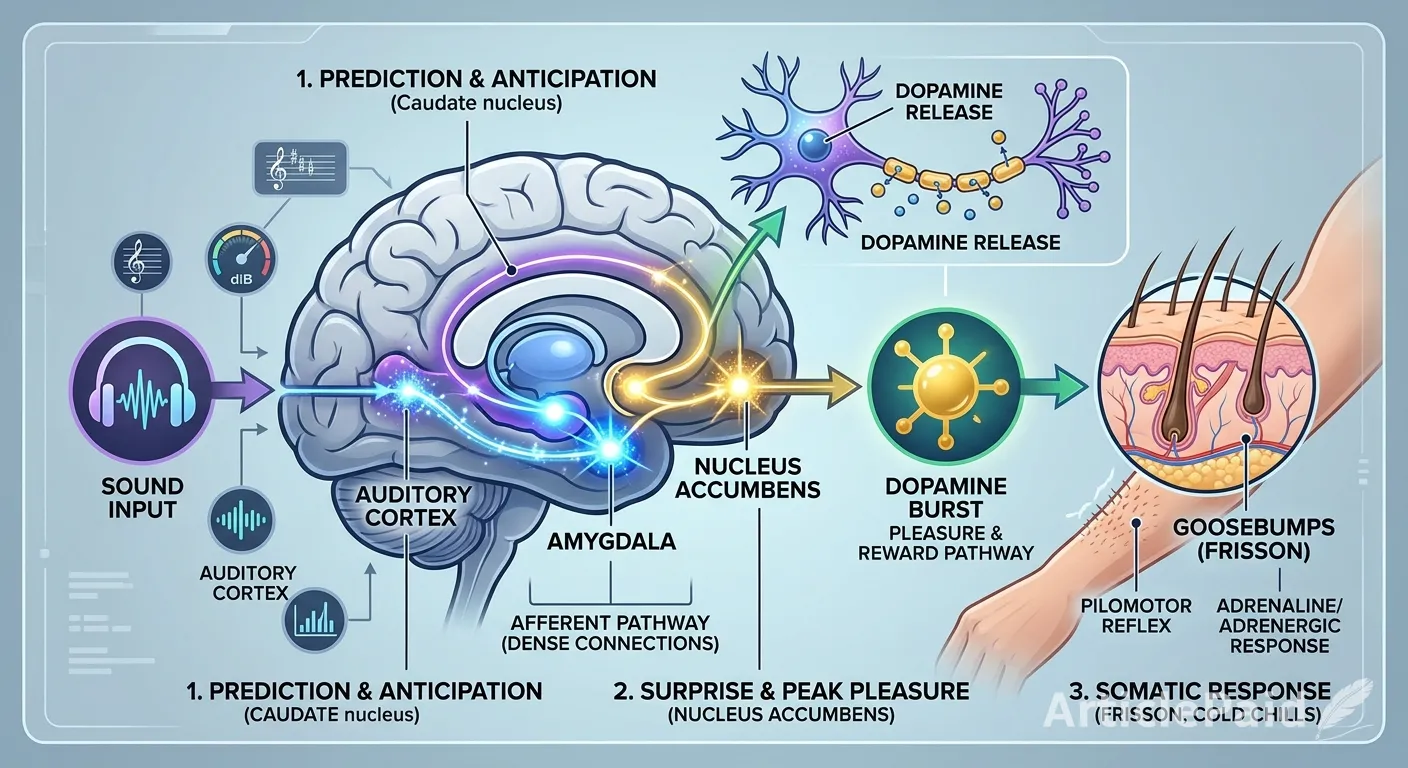
Goosebumps originally evolved as a survival mechanism. When early humans were cold, the tiny muscles around their hair follicles contracted to puff up their body hair, trapping a layer of warm air near the skin. When they faced danger—like encountering a predator—that same reaction made them look bigger and scarier to threats.
So, what does this have to do with your favorite song?
When a piece of music suddenly shifts—like an unexpected key change, a sudden swell in volume, or a solo voice entering a quiet room—your brain’s emotional center (the amygdala) interprets that sudden shift as a potential surprise or threat. For a fraction of a second, your body reacts as if something unexpected just happened in your environment, triggering a tiny spike of adrenaline that raises the hairs on your arm.
2. The Dopamine High
Here is where the magic happens. Almost instantly after that quick moment of surprise, your conscious brain catches up and realizes, "Oh, wait! That isn't a predator—it is just an incredible song!"
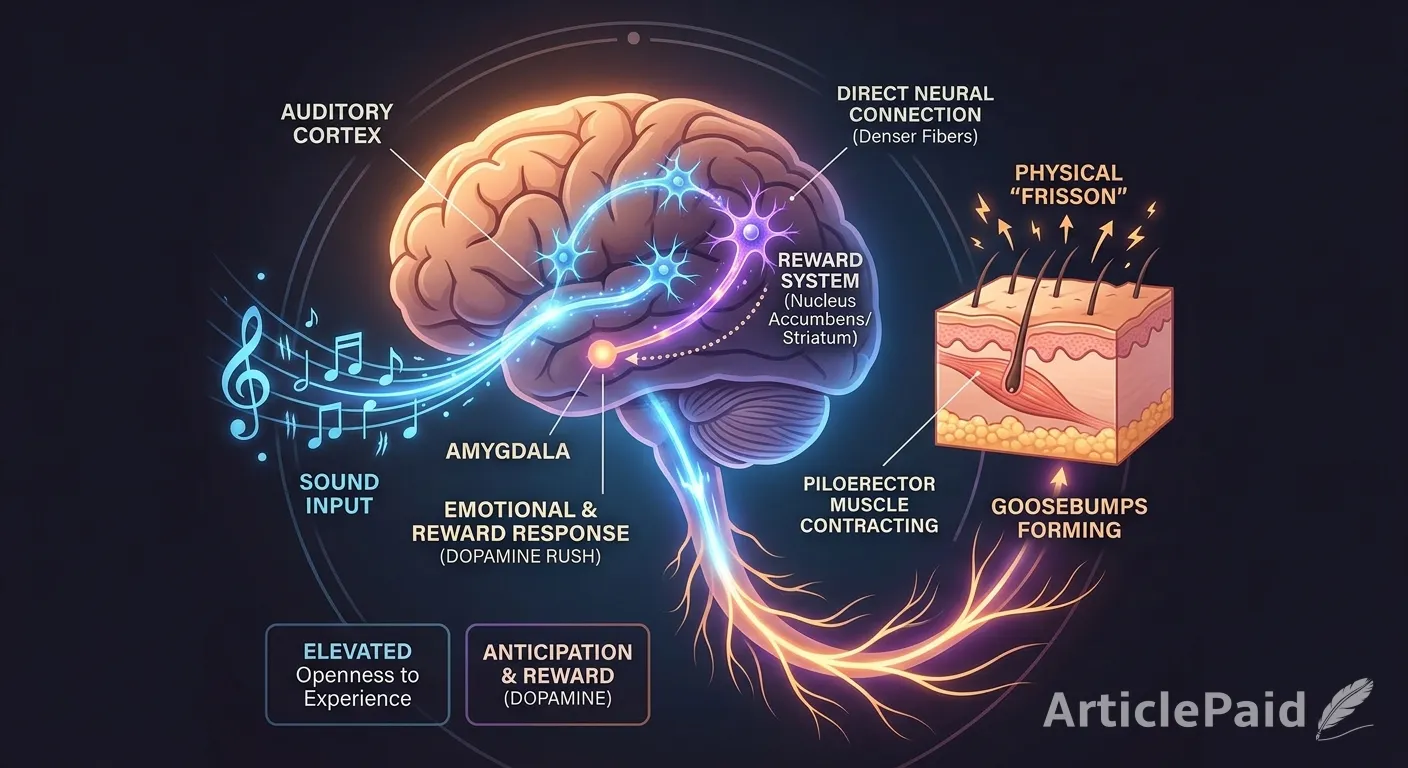
Once your brain recognizes that you are completely safe, it rewards you for the false alarm by flooding your system with dopamine—the brain’s feel-good neurotransmitter associated with pleasure and reward.
Brain imaging studies show that during a frisson moment, dopamine surges in two main areas of the brain:
- The Striatum (before the peak): As you anticipate your favorite part of a song coming up.
- The Nucleus Accumbens (during the peak): Right when the chill hits and the music reaches its emotional climax.This combination of a brief biological "surprise" followed by a rush of pleasure creates that thrilling, shuddering feeling across your skin.
3. Why Doesn't Everyone Get Chills?
If you get chills from music, you are actually part of a specific group! Research suggests that only about 50% to 60% of people experience music-induced frisson.So, why do some people feel it while others just hear plain sound?Psychologists at Harvard conducted brain scans on people who experience frisson versus those who do not. They discovered that people who get chills actually have a denser volume of nerve fibers connecting their auditory cortex (the part of the brain that processes sound) to their emotional processing centers.Because these brain regions communicate much more intensely, music has a direct pathway to trigger deep emotional and physical responses.Researchers also found that people who experience frisson tend to score high in a personality trait called Openness to Experience. They are often imaginative, emotionally expressive, curious, and prone to deeply absorbing art, nature, and beauty.The Secret Recipe for a Chill-Inducing Song
While everyone has personal musical tastes, scientists have found that certain musical elements are far more likely to trigger chills than others:- Sudden Dynamic Changes: A dramatic shift from quiet to loud (or loud to sudden silence).
- Harmonic Surprises: Unplanned key changes or unexpected chord progressions that break what your brain predicted would happen next.
- Climax and Crescendo: A slow, building buildup that finally explodes into a full chorus or solo.
- Human Vocal Intensity: High-pitched, emotional, or raw vocal solos that convey intense human feeling.
A Uniquely Human Connection
Ultimately, musical chills show us just how deeply connected our physical bodies are to our mental worlds. Music isn't essential for basic physical survival like food or water, yet our brains process a powerful melody using the exact same reward pathways as basic survival needs.The next time a song gives you goosebumps, take a moment to appreciate it. It is just your brain playing a clever evolutionary trick on itself—turning a simple sound wave into a wave of pure emotion!





















Responses (0)
Sign in to share your thoughts.
Sign in