
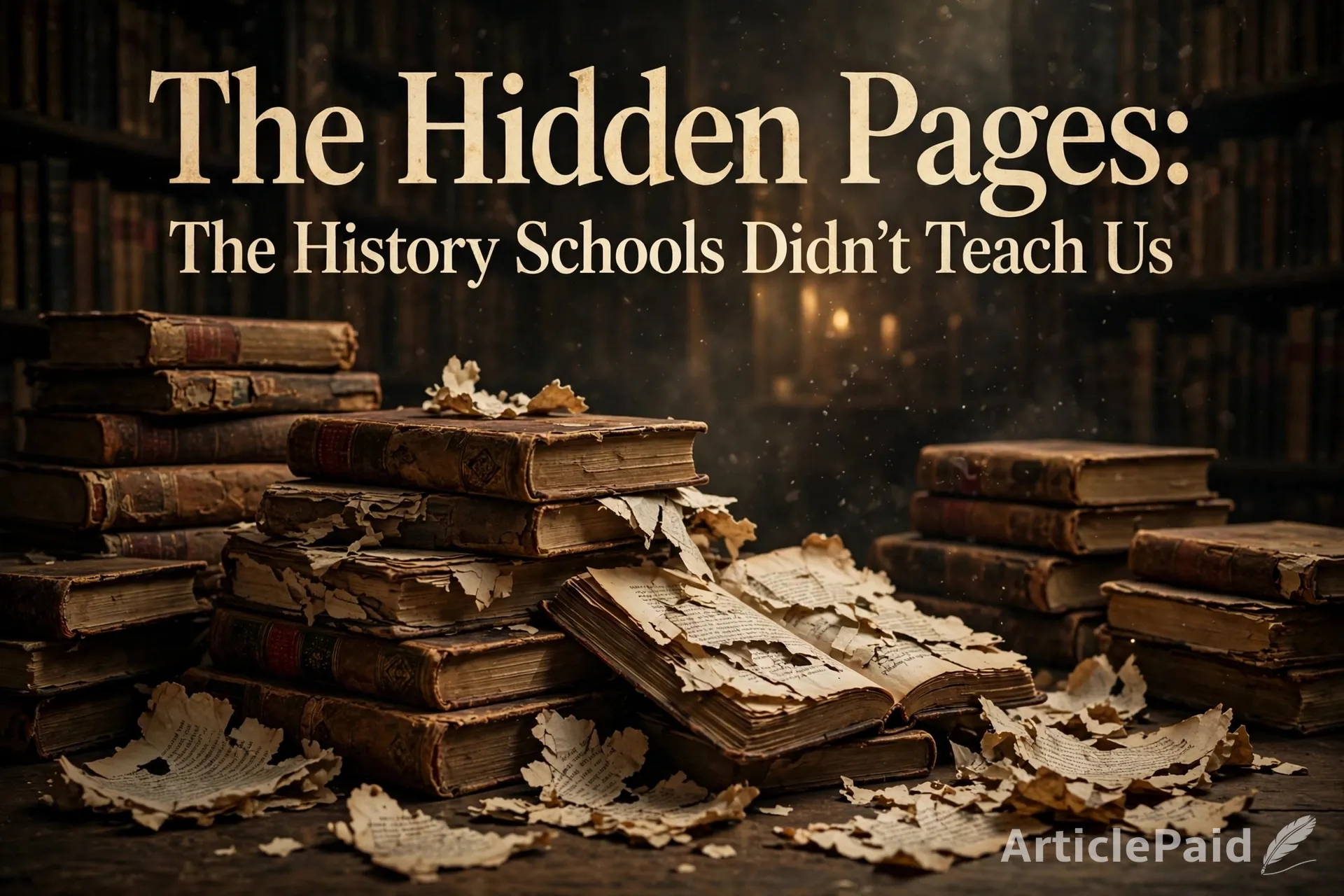
The Hidden Pages: The History Schools Didn’t Teach Us
History, as taught in school, is often a neatly packaged narrative—a simple sequence of empires, decisive battles, and famous conquerors. We memorize dates and boundaries, assuming we know the full story of human progress.
Yet, standard history resembles an edited movie; while the heroic scenes are showcased, the most complex, surprising, and influential moments are left on the cutting room floor.
When we look beyond the textbook, we uncover a hidden history driven not by kings and generals, but by quiet revolutions, cross-cultural exchanges, and suppressed ideas.
1. The Power of Shared Heritage

Standard curricula often present civilizations in isolation: Greeks gave us philosophy, Romans gave us law, and the modern West brought the Industrial Revolution.
This linear narrative ignores how knowledge actually evolved. During the medieval Islamic Golden Age, polymaths like Ibn al-Haytham revolutionized optics and scientific methodology, while Al-Khwarizmi developed algebra.
These discoveries weren't isolated milestones; they built the foundation for global modern science. Mainstream history often skips these essential bridge centuries, hiding the fact that human progress has always been a collaborative, international relay race.
2. Grassroots Movements Over Royalty
Textbooks are top-heavy, focusing almost exclusively on political rulers. However, true transformations in daily life rarely trickled down from a royal decree.
They bubbled up from ordinary people. The shift toward modern labor rights, public sanitation, and basic healthcare didn't start with kings; it was driven by everyday workers and unsung pioneers who fought for safer environments.
While textbooks praise the general who won the war, they frequently forget the agronomists and farmers whose quiet agricultural innovations saved billions from starvation.
3. erased Voices and Civilizations

History is notoriously written by the victors. When empires expanded, they routinely erased or understated the achievements of the societies they conquered.
Long before foreign interventions, complex urban centers, egalitarian governance models, and sustainable ecological systems flourished across Asia, Africa, and the Americas.
Reducing these rich cultures to brief, tragic footnotes deprives us of valuable lessons on how human societies can thrive in balance with their surroundings.
Why It Matters
Why does uncovering these forgotten chapters matter today? Because the narrative we construct about our past shapes how we view our present and build our future.
When history is taught solely as a timeline of conquerors, it conditions us to view human existence as an endless struggle for power. But when we restore the missing pages—the cross-cultural ideas, grassroots strength, and forgotten innovations—we see that history is deeply communal.
Understanding the full, unfiltered truth helps us build a more empathetic and interconnected world.
















Responses (0)
Sign in to share your thoughts.
Sign in