List of water bodies names in english with pictures
This blog post shares the names of different water bodies in English, such as rivers, lakes, oceans, and more, along with clear and helpful pictures. It’s

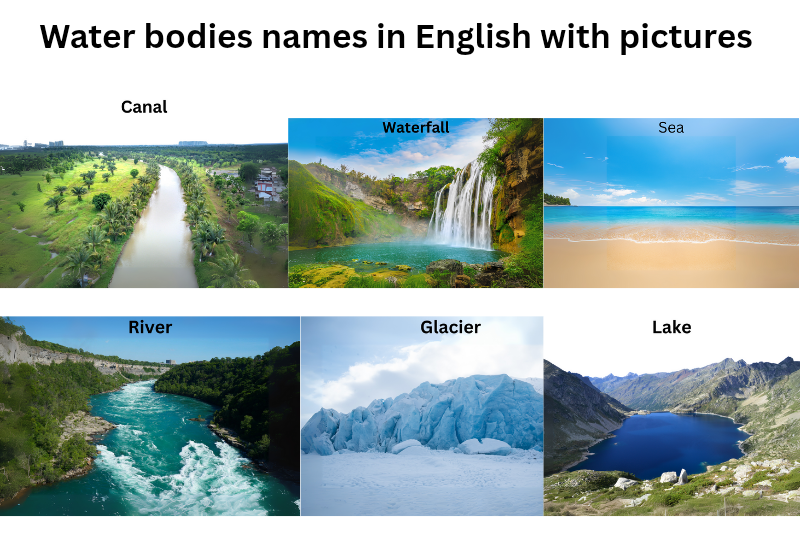
This blog post shares the names of different water bodies in English, such as rivers, lakes, oceans, and more, along with clear and helpful pictures. It’s perfect for learners of all ages who want to improve their English and general knowledge while enjoying simple explanations and beautiful water-related visuals.
No.1 Canal
A canal is a man-made waterway built to carry boats or transport water from one place to another. Unlike rivers, canals are usually straight and controlled by gates or locks. They are often used for irrigation, trade, and connecting cities or rivers. Canals help in managing water supply and reducing transportation costs. Many are lined with walking paths or used for tourism and leisure boat rides. They’re a smart example of how humans have shaped water routes for both economic and practical benefits.
No.2 Lake
A lake is a large, still body of water surrounded by land. It can form naturally through melting glaciers, volcanic activity, or by filling low-lying land with rainwater or river flow. Lakes are found all over the world and Lake sizes vary greatly, from small ponds a few square meters in area to vast bodies of water like the Caspian Sea, which is larger than 370,000 square kilometers. They support many life forms such as fish, birds, and aquatic plants. Lakes also provide drinking water, irrigation for farming, and recreational activities like boating and fishing. Some are seasonal, while others remain year-round. Calm and beautiful, lakes are peaceful spots in nature.
No.3 Ocean
Oceans cover more than 70% of the Earth’s surface and are the largest bodies of saltwater on the planet. There are five main oceans—Pacific, Atlantic, Indian, Southern, and Arctic. Oceans are home to countless marine species, from tiny plankton to giant whales. They play a huge role in climate control, oxygen production, and water cycles. Oceans also support global trade and fishing industries. Deep, vast, and largely unexplored, oceans are full of mystery and beauty. Their tides and currents are driven by the Moon’s gravity and Earth’s rotation, shaping coastlines and weather patterns worldwide.
No.4 Pond
A pond is a small body of still or slow-moving water, usually smaller than a lake. It can form naturally through rain, melted snow, or springs, and is often shallow enough for sunlight to reach the bottom. Ponds are rich ecosystems, home to frogs, insects, fish, plants, and birds. In rural areas, they’re also used for irrigation or as fish farms. Ponds are easy to explore and observe, making them perfect for children and nature lovers. Though small, they play an important role in biodiversity and serve as peaceful habitats for many living organisms.
No.5 River
A river is a flowing body of water that moves from higher land to lower ground, usually ending in a sea, lake, or ocean. Rivers begin in hills or mountains from melting snow, rainfall, or natural springs. Along the way, they provide water for drinking, farming, and power generation. Rivers shape the land through erosion and support many ecosystems. Famous rivers like the Nile, Ganges, and Amazon have been vital to human civilizations for centuries. People often settle near rivers for fresh water and fertile soil. Rivers are powerful yet calming, and they connect many parts of the world.
No.6 Sea
A sea is a large body of saltwater that is smaller than an ocean and often partly enclosed by land. Seas are connected to oceans and can be found along coast lines. They are important for marine life, fishing, shipping, and tourism. Famous seas include the Mediterranean Sea, Arabian Sea, and South China Sea. Seas provide food, help regulate climate, and support millions of people worldwide. Their waves are influenced by wind and tides, and their beaches attract visitors for relaxation and fun. Seas are a vital part of Earth’s water system and human history.
No.7 Waterfall
A waterfall is a natural feature where water flows over the edge of a cliff or rock, falling from a height into a river or pool below. Waterfalls are formed when a river or stream passes over a steep area or resistant rock. They create stunning views and powerful sounds. Some waterfalls are small and gentle, while others, like Niagara Falls, are massive and world-famous. Waterfalls are often tourist attractions and can also help in generating hydroelectric power. Their beauty and motion bring a sense of wonder, making them one of nature’s most admired sights.
No.8 Glacier
A glacier is a massive, slow-moving body of ice that forms over many years from compacted snow. Found mostly in polar regions and high mountains, glaciers store fresh water and shape the landscape by carving valleys and forming lakes. As they move, they break and grind the rock beneath them. Glaciers are important indicators of climate change, as they melt faster when global temperatures rise. They also feed rivers and provide water to millions of people. Though quiet and slow, glaciers are powerful natural forces that have shaped Earth’s surface for thousands of years.













Responses (0)