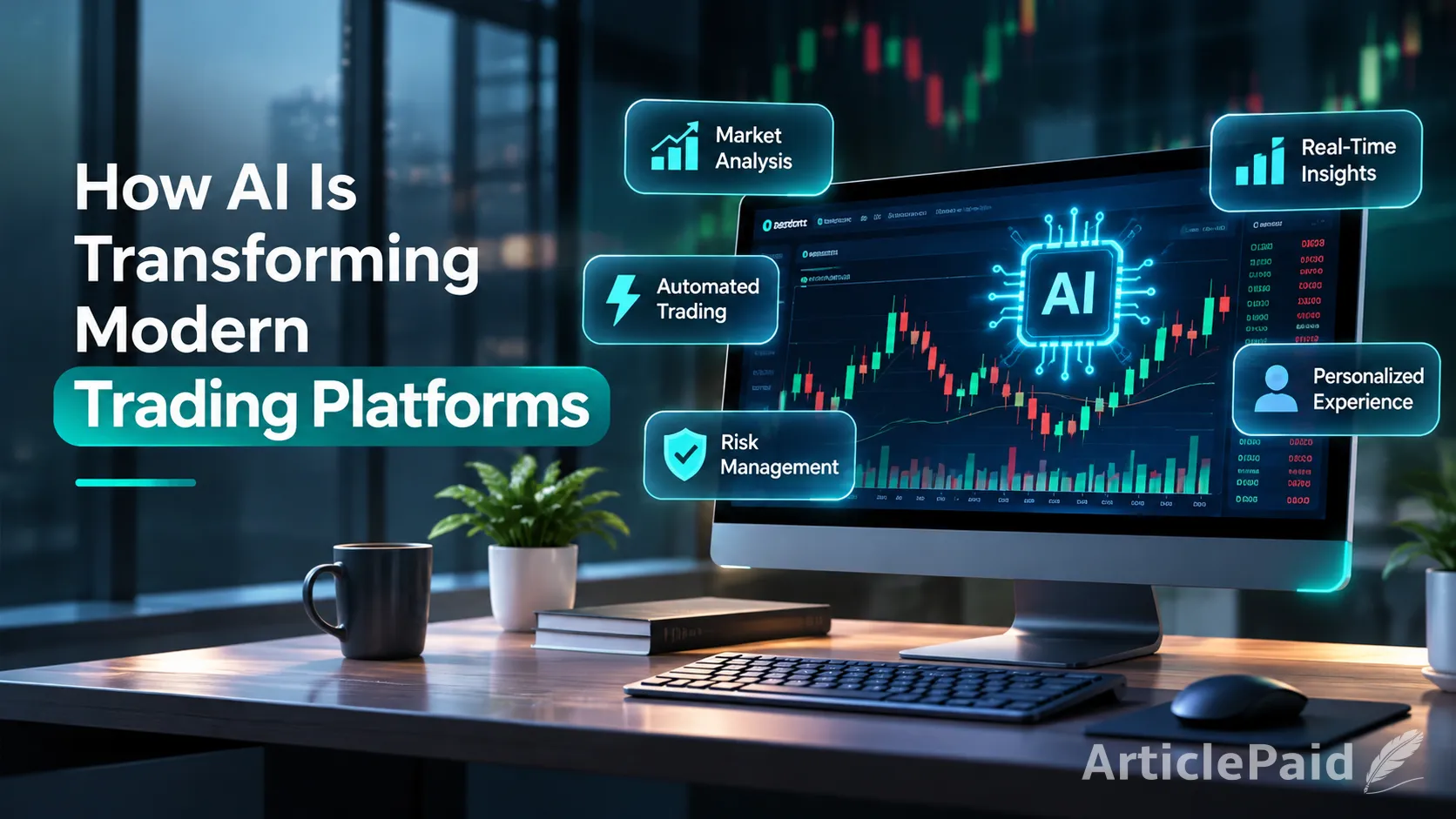
How AI Is Transforming Modern Trading Platforms – Market – Data
The financial markets are becoming increasingly data-driven, competitive, and technology-dependent. Traders, brokers, financial institutions, and…

In this article 17 sections
- 1. Smarter Market Analysis and Trend Prediction
- 2. Automated Trading and Execution
- 3. Real-Time Data Processing and Market Insights
- 4. Improved Risk Management and Fraud Detection
- 5. Personalised Trading Experiences
- 6. Natural Language Processing for Financial Research
- 7. Enhanced User Experience Through AI-Powered Features
- 8. Scalability and Intelligent Platform Architecture
- Key Challenges of Integrating AI into Trading Platforms
- How to Choose the Right Trading Application Development Partner
- Conclusion
- Frequently Asked Questions
- 1. How is AI used in modern trading platforms?
- 2. What are the benefits of AI in trading application development?
- 3. Can AI automate stock trading?
- 4. What technologies are used to build AI-powered trading platforms?
- 5. How do I choose a trading application development company?
The financial markets are becoming increasingly data-driven, competitive, and technology-dependent. Traders, brokers, financial institutions, and investment firms need platforms that can process large volumes of market data, respond quickly to changing conditions, and support informed decision-making. Traditional trading systems, which often rely on predefined rules and manual analysis, are evolving to meet these demands.
Artificial Intelligence (AI) is playing an important role in this transformation. From analysing market trends and identifying trading patterns to detecting unusual activities and improving risk management, AI is helping financial businesses make their trading operations more intelligent and efficient.
As a result, trading application development is moving beyond basic order placement and portfolio tracking. Modern platforms are increasingly integrating machine learning, predictive analytics, automation, and real-time data processing to deliver more advanced trading experiences.
Let's explore how AI is changing modern trading platforms and what businesses should consider when adopting these technologies.
1. Smarter Market Analysis and Trend Prediction
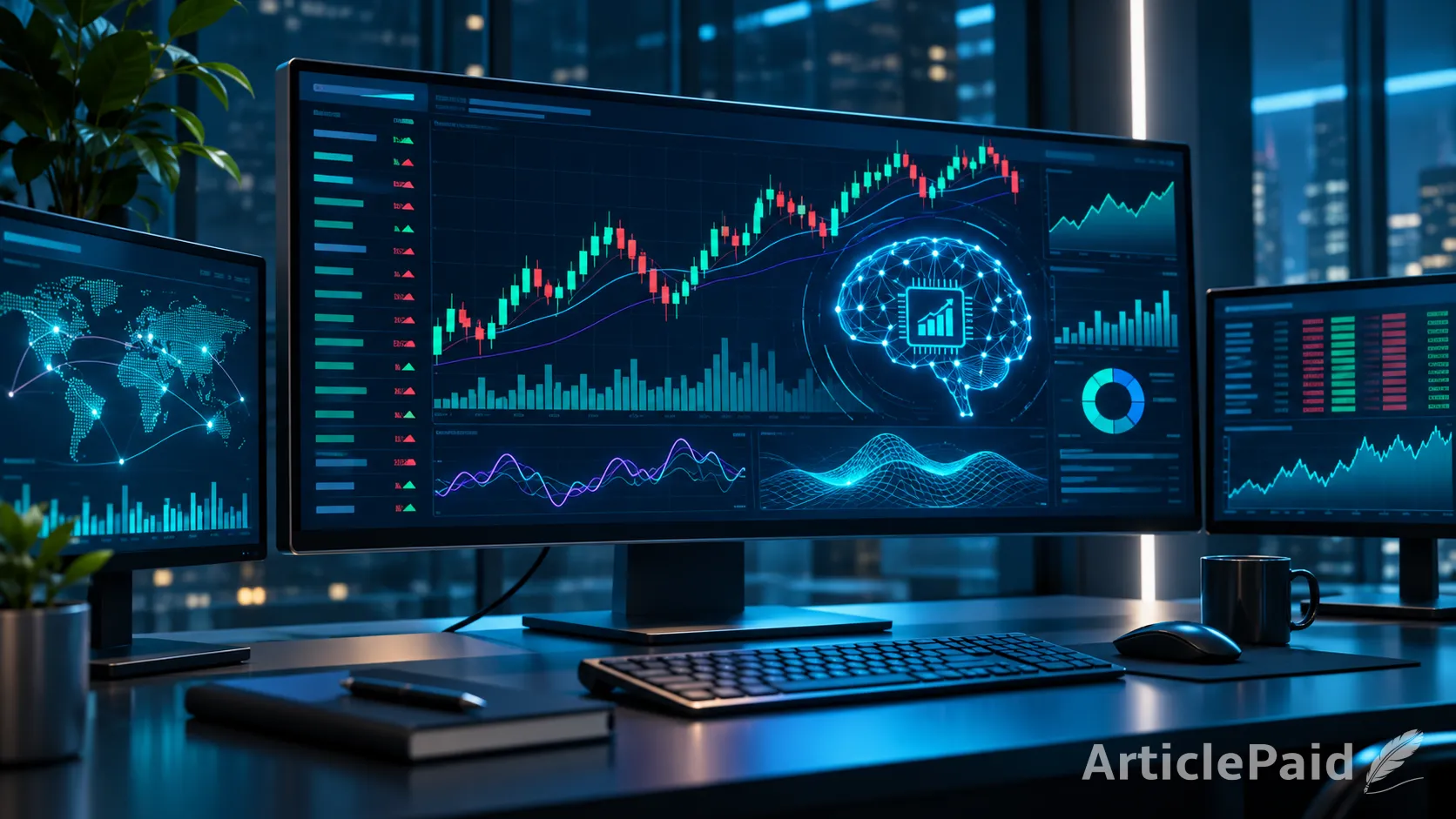
Market analysis has traditionally involved studying historical prices, financial reports, technical indicators, and economic events. Processing all this information manually can be time-consuming, particularly when market conditions change rapidly.
AI-powered trading platforms can analyse large datasets and identify patterns that may not be immediately visible through conventional analysis. Machine learning models can examine historical market behaviour, trading volumes, price movements, and other relevant indicators to generate analytical insights.
For example, an AI-enabled platform can analyse changes in trading volume alongside historical price movements to highlight unusual market activity. Traders can use these insights as additional information when evaluating potential opportunities.
However, predictions are not guaranteed outcomes. AI-generated insights should support informed decisions rather than replace professional judgement.
2. Automated Trading and Execution
One of the most significant applications of AI in financial markets is automated trading. Traditional algorithmic trading systems execute transactions based on predefined rules and conditions. AI can enhance these systems by helping analyse changing market conditions and refine analytical models.
AI-supported systems can assist with:
Identifying potential trading opportunities based on predefined parameters.
Analysing market movements and trading signals.
Evaluating execution strategies.
Monitoring order activity.
Supporting automated trading workflows.
For example, an institutional trading platform may use machine learning models to analyse market liquidity and historical execution data before recommending an appropriate order execution strategy.
The actual execution process must still follow the platform's risk controls, permissions, and applicable trading regulations. Speed and reliability remain essential considerations, particularly in low-latency trading environments.
3. Real-Time Data Processing and Market Insights
Modern financial markets generate enormous amounts of information every second. Trading platforms must process market feeds, order updates, price changes, and transaction information without introducing unnecessary delays.
AI can help make this information more useful by identifying patterns, detecting anomalies, and generating relevant insights from complex datasets.
For instance, a trading platform can combine historical price information with real-time market data to highlight significant changes in trading behaviour.
This makes real-time data processing an important consideration in trading application development. Developers need to build systems capable of handling high data volumes while maintaining low latency, stability, and accuracy.
A well-designed platform should also include efficient data pipelines, reliable APIs, and monitoring mechanisms to ensure consistent performance during periods of high market activity.
4. Improved Risk Management and Fraud Detection
Risk management is a critical component of every trading platform. Unexpected market movements, unusual transaction patterns, unauthorised access, and operational failures can create significant financial and security risks.
AI-powered monitoring systems can help identify suspicious patterns by analysing transaction histories, account activity, trading behaviour, and other relevant information.
Some practical applications include:
Detecting unusual transaction patterns.
Identifying potentially suspicious account activity.
Monitoring abnormal order behaviour.
Supporting fraud detection workflows.
Highlighting potential portfolio risk exposures.
For example, if an account suddenly generates transaction activity that differs significantly from its established behaviour, an AI-based monitoring system can flag it for further investigation.
AI does not eliminate financial risk or guarantee fraud prevention. Its effectiveness depends on data quality, model performance, security controls, and appropriate human oversight.
5. Personalised Trading Experiences
Different traders have different requirements. Retail investors may prioritise simple interfaces and portfolio visibility, while professional traders may need advanced charts, detailed market information, and sophisticated order management capabilities.
AI can help platforms deliver more personalised experiences by analysing user preferences, interaction patterns, and selected account information.
For example, a platform could organise relevant market information based on a user's watchlist or display customised portfolio insights.
AI-powered assistants can also help users navigate platform features, understand available information, and access relevant account details.
Personalisation should always respect user privacy, data protection requirements, and account permissions. Financial recommendations must also be handled carefully to avoid presenting automated insights as guaranteed investment advice.
6. Natural Language Processing for Financial Research
Natural Language Processing (NLP) allows AI systems to understand and analyse human language. In trading environments, this technology can help process financial news, company announcements, earnings reports, and other text-based information.
Instead of manually reviewing hundreds of documents, financial professionals can use AI-assisted tools to summarise information and identify relevant themes.
For example, an AI-powered research assistant could summarise an earnings announcement and highlight changes in revenue, operating expenses, or management guidance.
Sentiment analysis can also help identify positive, negative, or neutral language in financial news and market commentary.
These capabilities make financial research more accessible and help traders spend less time searching through large volumes of information.
However, NLP outputs need validation because automated systems can misinterpret context, market terminology, or incomplete information.
7. Enhanced User Experience Through AI-Powered Features
A trading platform's success depends not only on its backend technology but also on how easily users can access and understand its features.
AI can improve the user experience through intelligent search, conversational assistants, automated notifications, and contextual information.
Consider a trader who wants to understand recent changes in a particular stock. Instead of navigating several screens, an AI-powered assistant could help locate relevant market data, display historical information, or summarise available research.
Other useful features include:
Intelligent search and navigation.
Automated portfolio summaries.
Customised market alerts.
AI-powered customer support.
Contextual dashboards and reporting.
When these features are integrated properly, they can make complex financial platforms easier to use without compromising access controls or data security.
8. Scalability and Intelligent Platform Architecture
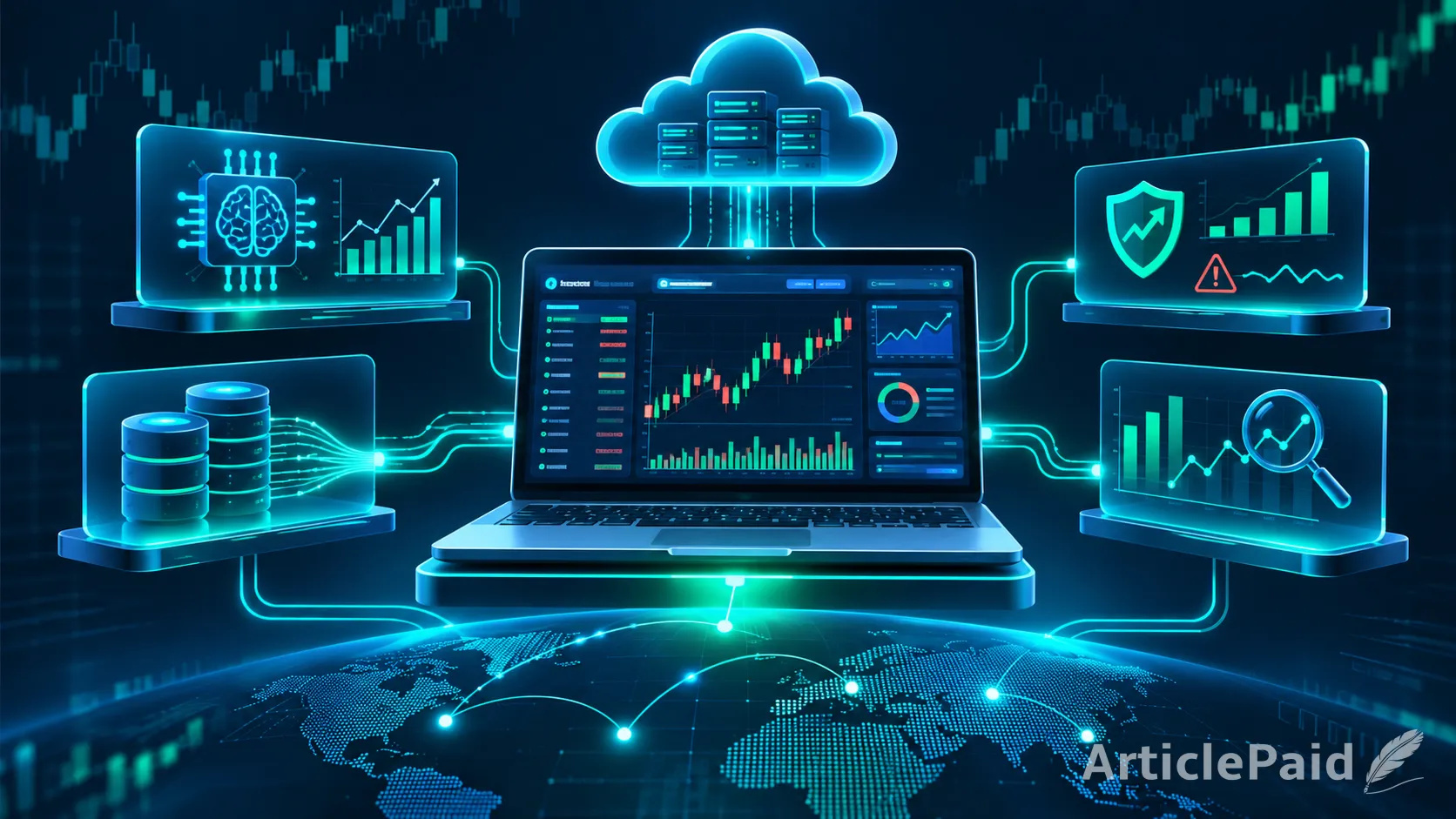
As trading activity increases, platforms must support more users, transactions, market data updates, and integrations. AI features introduce additional infrastructure requirements, including data storage, model processing, and monitoring.
This makes system architecture an important part of modern trading software.
A scalable trading platform may include:
Microservices-based architecture for independent system components.
High-performance APIs for communication between services.
Real-time data streaming infrastructure.
Secure authentication and access management.
Cloud infrastructure for flexible resource management.
Automated testing and continuous monitoring.
Developers must also consider how AI models interact with existing trading engines. A complex AI model should not introduce unnecessary latency into a time-sensitive order execution process.
The right architecture depends on the platform's purpose, expected trading volume, regulatory requirements, and performance objectives.
Key Challenges of Integrating AI into Trading Platforms
Although AI offers several advantages, implementing it in financial applications requires careful planning.
Some important challenges include:
Data quality: Inaccurate, incomplete, or outdated data can affect model outputs and analytical reliability.
Security and privacy: Financial platforms process sensitive information and require strong encryption, authentication, and access controls.
Model transparency: Developers and financial institutions need to understand how AI systems generate outputs and identify potential model limitations.
Latency and performance: Complex models may require significant computing resources, making performance optimisation essential.
Regulatory compliance: AI-enabled financial applications must account for applicable financial regulations, data protection requirements, and auditability.
Addressing these challenges during development can help businesses build more dependable and sustainable trading solutions.
How to Choose the Right Trading Application Development Partner
Building an AI-enabled trading platform requires expertise in financial technology, software architecture, data processing, security, and system performance.
Businesses should evaluate potential development partners based on their understanding of trading workflows, ability to design scalable systems, technical capabilities, and quality assurance processes.
When evaluating trading application development Services, consider the following factors:
Financial technology experience: Look for an understanding of trading workflows, market data, and order management systems.
Scalable architecture: Ensure the development team can design systems that support increasing transaction volumes.
Security expertise: Prioritise secure data handling, authentication, and access management.
Integration capabilities: Evaluate experience with APIs, market data feeds, and third-party financial systems.
Long-term support: Choose a partner that can support testing, maintenance, performance optimisation, and future upgrades.
H&H Infotech brings experience in developing trading applications and large-scale, distributed real-time systems. With a focus on quality, reliability, and scalable technology solutions, the company works in the trading technology domain to help businesses address complex software requirements.
Conclusion
AI is changing how modern trading platforms analyse information, manage risks, process market data, and support users. Its applications extend from predictive analytics and automated workflows to fraud detection and personalised trading experiences.
However, successful AI integration requires more than adding intelligent features. Businesses must also invest in reliable architecture, secure data infrastructure, performance optimisation, and appropriate human oversight.
As financial markets continue to evolve, organisations that combine AI capabilities with dependable software engineering will be better positioned to develop trading platforms that meet changing business and user requirements.
If your business is planning to build, upgrade, or modernise a trading platform, choosing an experienced technology partner is an important first step. H&Hcan help you explore technology solutions aligned with your trading application requirements.
Frequently Asked Questions
1. How is AI used in modern trading platforms?
AI is used for market analysis, pattern recognition, predictive modelling, automated workflows, fraud detection, risk monitoring, and personalised user experiences.
2. What are the benefits of AI in trading application development?
AI can help analyse large datasets, identify unusual market patterns, improve risk monitoring, support faster research, and enhance trading platform functionality.
3. Can AI automate stock trading?
Yes. AI can support automated trading by analysing market information and generating signals or execution inputs. However, automated trading requires appropriate controls, testing, and human oversight.
4. What technologies are used to build AI-powered trading platforms?
Common technologies include Python, machine learning frameworks, real-time data streaming systems, APIs, cloud infrastructure, databases, and high-performance backend architectures. The technology stack depends on the platform's requirements.
5. How do I choose a trading application development company?
Evaluate its financial technology experience, system architecture expertise, security practices, integration capabilities, testing processes, and long-term maintenance support.







Responses (0)